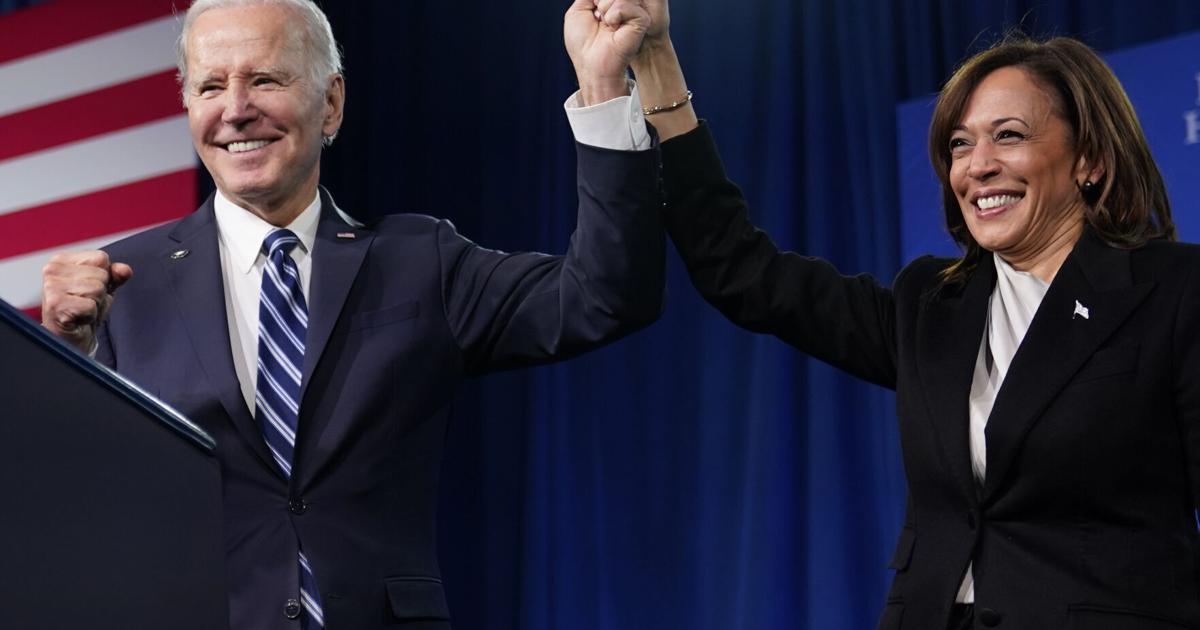
President Joe Biden and Vice President Kamala Harris attend the Democratic National Committee’s winter meeting in February 2023 in Philadelphia. The 59-year-old Harris was endorsed by Biden on Sunday, July 21, 2024, after he stepped aside amid widespread concerns about the viability of his candidacy at age 81.
Patrick Semansky | AP file photo
Joe Biden walks away from the presidency as the first eligible incumbent to decline to seek election since Lyndon Johnson in 1968, bowing to pressure from within his own party amid sagging poll numbers.
But in just 3½ years in office, Biden’s administration transformed West Virginia’s energy and environmental landscape, ushering in hundreds of billions of dollars of investment in renewable energy infrastructure and jobs while contradictorily opening the state up to massive gas industry-backed, multimillion-dollar projects that could lock the state into fossil fuel infrastructure for years to come.
West Virginia climate advocates say, though, that the Biden regime has been a net positive for the state.
But many of the advances made by the Biden administration are subject to change. They likely would be protected and strengthened by his probable successor atop the Democratic ticket, Vice President Kamala Harris, given her past climate advocacy.
They almost certainly would be rolled back or wiped out by a second Donald Trump administration, given the Republican nominee’s track record of undercutting environmental protections as president and erroneous questioning of the scientific consensus that climate change exists.
“President Biden’s administration has shifted the conversation on climate change,” West Virginia Citizen Action Group organizing director Dani Parent said.
“President Biden is, without a doubt, the greatest climate president we have ever had,” said Jim Kotcon, chair of the West Virginia Chapter of the Sierra Club.
Biden’s poll numbers were in a tailspin when he announced he was withdrawing his candidacy on July 21. But his administration’s numbers stand tall when it comes to investment in a more sustainable future in West Virginia.
West Virginia has been the site of some $1 billion in private investments in clean energy manufacturing and technology announced since Biden signed into law the 2021 Infrastructure Investment and Jobs Act aimed largely at boosting clean energy jobs.
A report tallying those investments throughout the country earlier this year found such investments in West Virginia surpassed those in every neighboring state except Ohio, approaching the $1 billion mark with over 5,000 permanent jobs projected.
The new report from Climate Power, a climate action-focused communications firm, recounted announcements for battery, electric vehicle and other clean energy technology projects with announced private investments totaling $938 million and estimated creation of 5,095 jobs since 2022.
The report tallied 523 total new clean energy projects totaling 271,713 new jobs and more than $352 billion in investments across 47 states and Puerto Rico since the 2022 passage of the Inflation Reduction Act.
The landmark law for climate and clean energy investments, extending and enhancing tax credits for renewable energy and providing grant funding for greenhouse gas reductions, was critically backed by Sen. Joe Manchin, I-W.Va., with no congressional Republican support.
The projects in West Virginia counted by Climate Power are:
Sparkz battery factory in Taylor County
Pure Watercraft electric pontoon manufacturing in Brooke County
Clean-Seas West Virginia plastic feedstock conversion in Kanawha County
Our Next Energy battery storage system factory in Jackson County
GreenPower electric school bus manufacturing in Kanawha County
Form Energy iron-air battery manufacturing and Boston Metal chromium metal and high-temperature alloy factories, both in Weirton
Coal jobs rose under Biden after falling under Trump
Coal mining jobs increased 16.2% under Biden from January 2021, the month he took office, to over 44,000 nationwide May 2024, according to Federal Reserve Bank of St. Louis data. Coal mining jobs had decreased 24.8% in Trump’s four years in office, including an 11.6% drop before the COVID-19 pandemic in March 2020.
West Virginia Coal Association president Chris Hamilton, an ardent critic of what he has viewed as a significant coal industry threat in the Biden administration, denied the industry has fared better under Biden than Trump.
Hamilton asserted that Obama administration policies affected the industry severely enough to cause adverse effects lasting into Trump’s presidency, with Biden in turn benefiting from a “robust coal and energy run” under Trump.
United Mine Workers of America spokeswoman Erin Bates declined to comment on Biden’s impact.
Two laws, $5 billion-plus for West Virginia
Gov. Jim Justice has opposed the Inflation Reduction Act and heavily criticized Biden as governor and a U.S. Senate candidate. But his administration set up an online resource called the West Virginia Infrastructure Hub that shows the enormous in-state impact of the Infrastructure Investment and Jobs Act and Inflation Reduction Act.
The site, aimed at connecting communities with federal funding opportunities, reports West Virginia has received $5.78 billion in total funding through the two laws.
“Even Republicans can’t help but cut ribbons on projects funded by Biden’s initiatives,” Parent said, alluding to Republican members who have applauded projects powered by laws they voted against.
This month, Sen. Shelley Moore Capito, R-W.Va., who voted against the Inflation Reduction Act, toured Form Energy’s Weirton plant catalyzed in part by the law.
How gas and oil have thrived under Biden administration
Of over $337 million West Virginia has allocated through the Inflation Reduction Act, nearly $38 million has been earmarked for the Methane Emissions Reduction Program designed to help reduce emissions of methane and other greenhouse gases from the oil and gas sector.
West Virginia’s gas and oil industry-linked cancer risks are among the highest in the country, according to a 2022 analysis of EPA data by Clean Air Task Force, an environmental nonprofit.
Of the 33 counties nationwide with a cancer risk due to gas and oil pollution above 1 in 250,000, four were in West Virginia:
Doddridge
Ritchie
Tyler
Wetzel
Pipe dated July 2016 sits near the route of the Mountain Valley Pipeline near the edge of Lewis County landowner Suzanne Vance’s property in this May 2023 photo.
MIKE TONY | Gazette-Mail
Amid West Virginia’s vulnerability to gas and oil pollution, the Biden administration green-lit the long-delayed Mountain Valley Pipeline, a 303.5-mile, $7.85 billion gas pipeline crossing 11 counties in West Virginia with a long history of environmental violations and pipe safety concerns since it was first announced in 2014.
With Biden’s signature and pivotal support from Manchin, Congress mandated the pipeline’s completion through a provision in 2023 debt ceiling legislation, drawing the ire of West Virginia community and environmental advocates.
Mountain Valley Pipeline developers have estimated that total life-cycle emissions from the pipeline that went into service on June 14 would range from 48 million to 57 million metric tons of greenhouse gases per year.
The 42-inch-diameter pipeline is designed to cross more than 75 miles of slopes greater than 30%, an unusually high amount of pipeline over slopes that steep, fueling slope stability concerns exacerbated by a pipeline rupture during water pressure testing in Virginia in May.
In October, Biden’s Department of Energy selected for up to $925 million in funding a planned regional hydrogen production network vigorously opposed by residents and climate advocates.
The project widely backed by West Virginia political and business leaders, the Appalachian Regional Clean Hydrogen Hub (ARCH2), was selected through the Infrastructure Investment and Jobs Act.
The DOE has predicted ARCH2 will yield thousands of jobs while lowering emissions from hard-to- decarbonize industrial sectors. Mountain Valley Pipeline developers estimate the 11 West Virginia counties along the pipeline route would receive a combined $35 million annually in tax revenue from the project.
But opponents say they fear a buildout of what could become stranded fossil fuel infrastructure assets like pipelines, toxic groundwater pollution and a lack of economic benefits from a gas and oil industry not as job-intensive as the coal industry or other fields.
The Federal Reserve Bank of St. Louis estimates that jobs in the mining, quarrying and oil and gas extraction sector have declined roughly 29% in the past decade.
“These projects, while promising short-term economic gains, risk undermining our climate progress,” Parent said. “It’s crucial that we find a balance between economic growth and environmental protection, as these compromises highlight a gap between climate rhetoric and reality.”
Unlike Harris during her failed 2020 presidential campaign, Biden has declined to support a ban on “fracking,” or hydraulic fracturing, a method to drill deep underground to extract gas and oil from shale rock that can trigger earth tremors and sustains fossil fuel use driving climate change.
The U.S. produced more crude oil than any nation at any time for the past six years in a row, the U.S. Energy Information Administration said in March. Natural gas production in the Appalachian region increased under Biden.
When asked to reflect on Biden’s energy legacy in West Virginia, the Gas and Oil Association of West Virginia pointed to past statements by president Charlie Burd calling ARCH2 “a clear win for our economy, workforce and environment” and opposing the Biden administration’s temporary pause on review of pending applications to export liquefied natural gas to countries with which the U.S. doesn’t have free trade agreements.
Climate progress at stake
Energy and environmental policy under Biden is making a difference in the fight against climate change, according to a report released Tuesday by the Rhodium Group, a nonpartisan research group.
The Rhodium Group’s outlook found the U.S. could slash emissions by 32-43% below 2005 levels in 2030, which it called a “measurable acceleration in mitigation even compared to” a 2022 estimate just before passage of the Inflation Reduction Act finding the U.S. on track for a 24-35% reduction below 2005 levels in 2030.
But the progress still isn’t enough for the U.S. to achieve an international climate commitment of 50-52% by 2030.
That’s where the next administration will come in.
The White House under Biden’s successor will have to address how to navigate permitting, grid interconnection and labor issues that have dogged renewable energy infrastructure projects, oversee the buildout of electric vehicle charging stations under the Infrastructure Investment and Jobs Act and either tout or undermine the Inflation Reduction Act.
Only about half of pro-climate voters said they are familiar with the Inflation Reduction Act in a survey released last month by the Yale Program on Climate Communication. But after reading a short description of it, nearly all pro-climate voters said they support it. The law garnered majority support even from voters who do not prioritize climate action.
The survey estimated there are nearly 60 million pro-climate voters in the U.S., a great majority of which said they plan to vote in the 2024 presidential election.
“In a close election — as 2024 is expected to be — these voters could be decisive,” program researchers said in a blog post.
Harris aggressive on climate
As a California senator in 2020, Harris sponsored the Environmental Justice For All Act, which would have established environmental justice requirements, advisory bodies and programs to address disproportionate adverse human health or environmental effects of federal programs low-income communities and communities of color.
The bill, S. 4401, would have provided grants for research on designing safer alternatives to chemicals in certain consumer, cleaning, toy and baby products.
Harris cosponsored a 2019 resolution contending the federal government has a “duty” to “create a Green New Deal” partly through a 10-year national mobilization that meets 100% of U.S. power demand through clean, renewable and zero-emission energy sources.
While Harris was California’s attorney general, the state sued Phillips 66 and ConocoPhillips over alleged environmental violations at gas stations, reaching an $11.5 million settlement in 2015. San Francisco added an environmental justice unit in Harris’ office during her tenure as district attorney there in 2005.
Sierra Club national political director Sarah Burton hailed Harris as “the climate leader we need” in an email to supporters Thursday.
‘Groundwork laid’
Climate action in the next presidency looms especially large in West Virginia given the state’s socioeconomic challenges and proneness to flooding and power outages made more frequent by climate-driven extreme weather.
Justice on Friday declared a State of Emergency for all 55 West Virginia counties due to dangerous drought conditions, an environmental threat exacerbated by the climate change he, like Trump, has questioned the scientific consensus behind.
Kotcon said he’s “appalled” that as a Republican, his party would nominate a convicted felon like Trump and “sacrifice the legacy of conservation” that he noted goes back to Republican presidents Abraham Lincoln and Theodore Roosevelt. In May, a New York jury found Trump guilty of all 34 charges in a scheme to illegally influence the 2016 election.
As Kotcon looks back, Parent looks around and sees a changing energy landscape in West Virginia to build on.
“The groundwork laid during this administration not only sets the stage for our state’s continued progress but also paves the way for a more sustainable future,” Parent said.