


To say that things are a bit tense at the moment between the U.S. and China is like saying Kendrick and Drake are just having a tiff. That’s what happens when a tariff war erupts. But that isn’t stopping Chinese restaurant brands from opening shops in America, with guidance from HungryPanda.
HungryPanda, the largest food-delivery platform in Asia, is playing a pivotal role in helping Chinese brands succeed in the U.S. by helping them simplify logistics, meet compliance standards, adjust delivery expectations, and create culturally relevant marketing strategies.


Kitty Lu, director of public affairs at HungryPanda
“There are a lot of variables to consider when entering the U.S.,” said Kitty Lu, director of public affairs at HungryPanda, in an interview. “A lot of Western fast food is easy to source for. But with Chinese food, you have stir fry, soup, hot pots. It’s not as simple. We’ve been working with a hot-pot franchise called Happy Lamb, which is big in China. Its problem is it can’t find sourcing for the meat that it wants, which has to be selected carefully so it has the texture it needs for slicing. That’s where we step in. We have restaurants in our network with similar sourcing needs and we can introduce them and make those connections.”
HungryPanda is working with brands in 10 countries, including the UK, France, Australia, and Canada. Lu says it starts by looking at a brand’s name.
“In China, one of the most beloved tea chains is Hu Shang Ayi, which means Auntie Jenny. But for America it changed its name to Auntea Jenny, with tea part of it. We worked with them on launching a shop in New York City in May and it is doing well,” she said.
Location is crucial. A brand may covet a hot neighborhood before HungryPanda splashes cold water on the idea.
“We advise brands on their competition,” she said. “A brand may want a boba tea shop in a certain location but we’ll say, Oh no, don’t go there, that street already has eight shops.”
Then it looks at costs, using its voluminous database as a resource. “We can tell a client how much labor will cost in a location to make the dishes on their menu,” she said. “This saves them time in their own research.”
And it can consult authoritatively on a brand’s off-premises approach and how it might differ from China.
“We analyze how efficient a delivery can be made so a brand knows which dishes to offer,” she said. “These choices might not always be the most authentic food but they are the most suitable for delivery. For example, a stir-fry dish with braised fish. We might suggest dishes that can be cooked faster.”
HungryPanda doesn’t stop there. It can also help a brand make decisions with packaging. “If you order Chinese food, the packaging is different. You have to consider how to keep the dishes warm longer, rather just using paper wrapping. We work with a lot of restaurants on using trivium metal packaging, which you can still seal to keep the food warm,” she said.


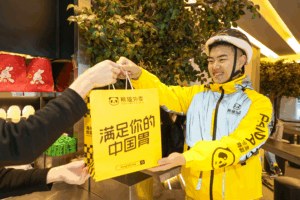


“The Chinese food-delivery industry has been growing,” she said. “In a way we’re taking what we have learned from the Asian market to new markets. We already know how to do it.”
And do it in spectacular ways. “You can order Starbucks to be delivered to you on the Great Wall of China, using drones,” she said.
By that standard, delivering boba tea through a busy Manhattan neighborhood is a snap.
HungryPanda also helps brands use data to design marketing programs for American audiences.
“We have a smart back-end data system so our partners can understand their customers,” she said. “Who has ordered my dishes before? When is it time to reach out with a voucher? When is it time to turn on promotions? We’re working with a Mala Xiang Guo brand, which is a small hot pot concept, and every month we set up a little store in front of its shop to give out free toys.”
The U.S. market is vast, as is the upside to HungryPanda for doing business here. But Lu insists the work is about more than the bottom line.
“We consider ourselves a culture ambassador for Asian food culture,” she said. “We have a social responsibility. We are carrying so many people, providing them with daily support. We want to help workers with their day-to-day life. That is our mission.”
You have Successfully Subscribed!
link