


A fragile cease-fire between Israel and Iran, following a surprise announcement by President Trump, has offered a glimmer of calm after nearly two weeks of intense warfare—fighting that has threatened significant damage to Iran’s cultural heritage. Israeli strikes since June 13 have hit key examples of Modern architecture in Tehran, while U.S. bombings over the weekend targeted military infrastructure near Isfahan, one of Iran’s most historically significant cities.
“The headquarters of the Iranian state broadcaster (constructed in the 1970s by the firm of the famous Iranian architect Abdol Aziz Farmanfarmaian), which was targeted a few days back, is not just a government building; it is a major work of architecture,” said Farshid Emami in an email. An art historian at Rice University in Houston, Texas, Emami is the author of Isfahan: Architecture and Urban Experience in Early Modern Iran (2024). The Israeli military targeted the building during a live broadcast.


The damaged building of the Iranian Radio and Television Broadcasting Corporation (IRIB) headquarters after it was reportedly targeted by an Israeli strike in Tehran on June 19, 2025. Photo: Fatemeh Bahrami/Anadolu via Getty Images.
“Tehran is not as historic as Isfahan, but it is home to several masterpieces of modern Iranian architecture built (especially) in the 1960s and 1970s,” said Emami. “There is great awareness of the significance of these monuments and the need for their preservation. One example is the Tehran Museum of Contemporary Art, a great work of architecture and home to one of the largest collections of modern Western art outside Europe and North America. There is very real concern about these buildings and museums in Tehran.”
TMoCA was designed by Iranian architect Kamran Diba and opened in 1977, at the height of Iran’s oil boom. It was at the center of a controversial 2021 memoir by Donna Stein, an American curator who lived in Tehran between 1975 and 1977 and assisted with the assembly of the famed collection.

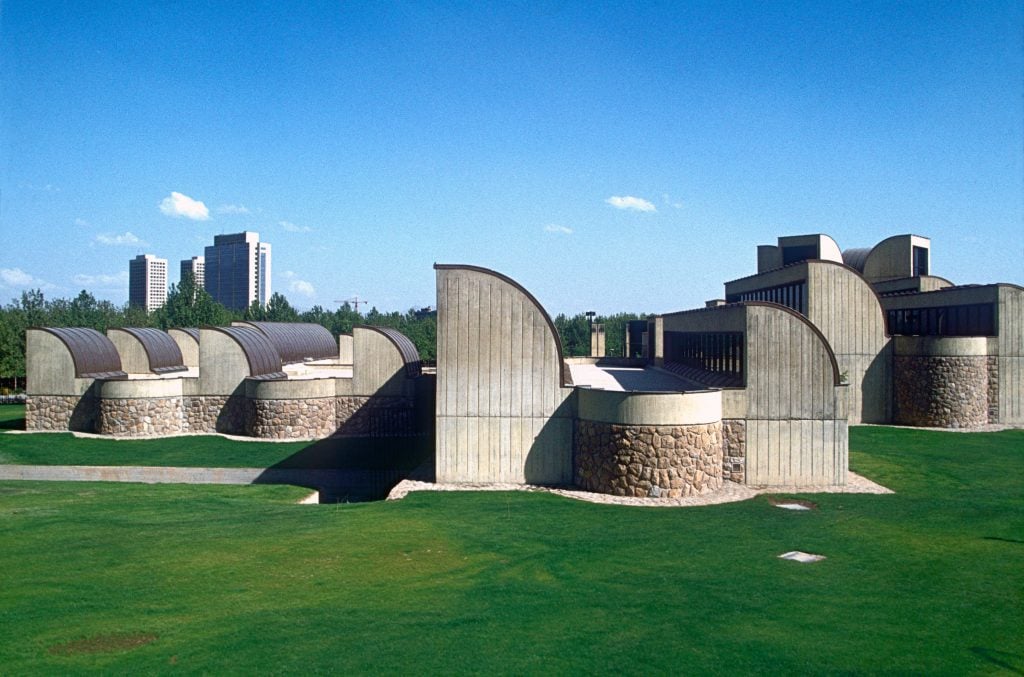
The Tehran Museum of Contemporary Art. Courtesy of Kamran Diba.
This past weekend, U.S. bombs fell on a nuclear complex 14 miles east of Isfahan, a city of over 2 million that sits on what was the crossroads of the main north-south and east-west trade routes that ran across Central Asia. CNN reported Sunday that satellite imagery revealed at least 18 destroyed or partially destroyed structures. Some 3,000 scientists were employed at Isfahan, according to the nonprofit Nuclear Threat Initiative.
Fortunately, Isfahan itself seems thus far to be unscathed. “I haven’t seen any news of damage to Isfahan’s historic landmarks in recent attacks,” said Emami.


Two Iranian women sit in front of the historical Ali Qapu Palace in Naqsh-e Jahan Square in the historic city of Isfahan, Iran, in 2025. Photo: Morteza Nikoubazl/NurPhoto.
According to a UNESCO report, the city was the capital of the Seljuq and Safavid dynasties, and is so renowned that it is the subject of an Iranian expression, “Isfahan is half the world.” The Safavid Shah Abbas I (1588–1629) “effectively re-routed the Silk Road through Isfahan and made the city his capital so that his empire would enjoy a trading monopoly,” says the report, adding that in the 17th century, European merchants, missionaries, and mercenaries convened on the cosmopolitan city.
During the Seljuq empire (1038–1194), a new, uniquely Iranian architecture emerged in the city, marked by large, vaulted spaces; buildings were decorated with complex brickwork patterns, and landmark urban structures were oriented around a town square known as a maidan.
The Seljuqs also became known for the large domed chambers in their mosques; an especially large one appears in the Masjed-e Jāmé, or Friday mosque, a UNESCO World Heritage Convention site located in the historic centre of Isfahan. The oldest preserved edifice of its type in the country, dating as far back as 841 C.E., it served as a model for later mosque designs throughout Central Asia. The complex covers 24,000 square yards and underwent some restoration and reconstruction after a 1984 air raid in the country’s war with Iraq.


Sheikh Lotfollah mosque in Naqsh-e Jahan square, Isfahan. Photo: DeAgostini / Getty Images.
Another UNESCO Heritage site, the Naqsh-e Jahan Square, or Image of the World Square, is at the city’s center and was constructed from about 1598 to 1629 C.E. Commanding an area of some 964,000 square feet, it is one of the world’s largest squares and is surrounded by examples of Safavid-era architecture that are also Heritage sites, including the Shah Mosque, whose construction began in 1611; Ali Qapu Palace, which opened in 1597; and the Sheikh Lotfollah Mosque, opened in 1619 C.E.
After the Seljuqs came the Safavid Empire (1502–1736), whose Shah Abbas I, who reigned from 1588 to 1629, made Isfahan the capital in 1590. Most of the city’s most recognizable and renowned monuments and buildings date to his reign. Bridges, roads, and caravanserais were built to encourage trade, and merchants and artisans followed the imperial household to the city.
Also under American attack over the weekend were nuclear facilities at Natanz, a central Iranian city of about 12,000, where, per CNN, six above-ground buildings and three underground structures constitute Iran’s largest nuclear enrichment center. The city is also home to the shrine of Abd as-Samad, the burial vault of a 13th-century Sufi sheikh, elements of which date back as far as 1303.
link