


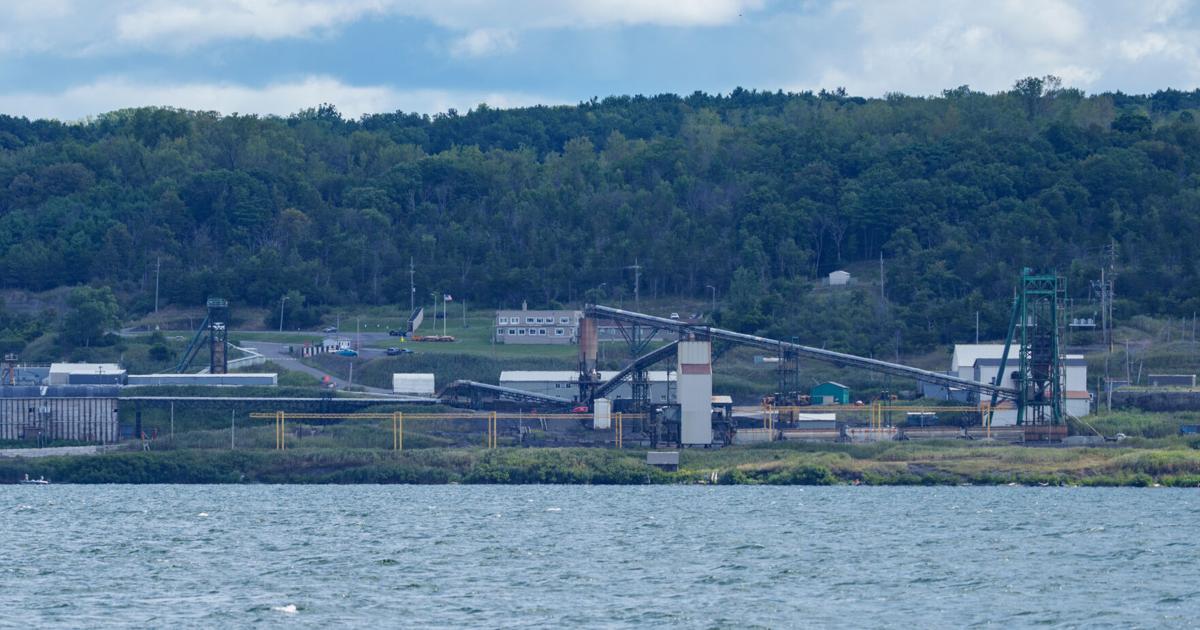
Following a move by New York state regulators, the renewal of a major industrial permit for the Cayuga Salt Mine has drawn opposition from environmentalists who argue the decision threatens local resources.
The New York State Department of Environmental Conservation (NYSDEC) issued a five-year permit modification and renewal to Cargill for the Cayuga Salt Mine on Aug. 15. The permit for the mine located at 191 Portland Point Road in Lansing will expire Aug. 14, 2030.
The permit authorizes Cargill to continue mining operations and contains a modification allowing the company to store brine in the abandoned S3 portion of the mine.
The permit requires that brine saturation levels are continuously monitored and maintained. Additionally, daily measurements are required for both water inflow into the mine and its disposal, including the brine saturation levels of the discharged water before it enters the S3 main.
The permit details specific conditions that Cargill must follow, including a requirement that mine activities do not affect the quality of ground and surface water. It requires Cargill to maintain a reclamation bond and general liability insurance for bodily injury and property damage.
A licensed blaster must conduct and monitor all blasting with a seismograph. Blasting is only permitted 9 a.m. to 5 p.m., Monday through Saturday, and injury or property damage must be prevented. Cargill must engage in dust control and water supply restoration or replacement. And the company must hire an independent mining engineering consultant to advise NYSDEC and submit an annual report on non-routine incidents, updated mining maps and monitoring data. Cargill must immediately notify NYSDEC of incidents that could affect mine stability, natural resources or public health and safety.
Cargill”s permit for salt mining has expired, but the company continues to operate under a provision of the New York State Administrative Procedures Act that allows operations to continue while a permit is under review. According to Cayuga Lake Environmental Action Now (CLEAN), the provision only applies to the existing salt mining operations. The group argues that Cargill’s recent water storage activities on the same underwater lands are not authorized by either the expired mining permit or the Office of General Services. CLEAN insists that the water storage lacks legal authority and should stop immediately.
NYSDEC oversaw a public comment period that saw 143 comments submitted between Feb. 12, 2024 to Jan. 22, 2025 from citizens, municipal officials and organizations such as CLEAN. NYSDEC reviewed the company’s application submitted on July 3, 2023. After the application was considered complete, the public was notified in late 2024. Due to public demand, the original public comment period set to expire on Dec. 20, 2024 was extended by 30 days and officially closed on Jan. 19.
In NYSDEC’s responsiveness summary, the department received multiple comments requesting a rescinding of the State Environmental Quality Review (SEQR) negative declaration for the permit. Instead, commenters urged for a full environmental impact statement (EIS) of the mine.
An EIS is a detailed analysis required under New York State law for certain projects that may have significant environmental impacts.
Commenters argued that a comprehensive review would address the effects of the mining operations over time, and that a potentially catastrophic event, however unlikely, could necessitate an EIS.
NYSDEC stated a rescinding of a SEQR determination must be based on specific criteria showing the action may have a significant adverse impact on the environment. The department said the current application only involves a change in water storage location to increase capacity and does not expand the mine area. NYSDEC’s review resulted in a negative declaration because no significant adverse impacts were identified. If Cargill applies for a future permit modification that expands the mine area, NYSDEC would evaluate it for potential cumulative impacts.
Commenters argued Cargill’s operations have not received the same scrutiny as other mining operations in New York because it has never been required to prepare an EIS under SEQR for its activities at the mine. One comment claimed to be aware of at least 16 instances where the DEC should have required an EIS but did not. In its response, NYSDEC stated there is no basis to reassess previously issued permit decisions and the only action under review for the application is the expansion of the water storage area.
The permit approval comes after both the Tompkins County Legislature and Ithaca Common Council passed resolutions demanding NYSDEC require an EIS for the mine.
CLEAN response
CLEAN stated that it will review NYSDEC’s decision and consider all options to ensure accountability from Cargill, including legal action. In a statement, CLEAN opposed the permit, stating NYSDEC issued it without requiring an environmental impact statement (EIS) or holding a public hearing.
CLEAN raised concerns about Cargill’s plan to flood the mine with undersaturated brine wastewater. In public comments, the group’s experts stated that actions risks mine stability beneath Cayuga Lake. The group argued Cargill’s safety evaluations were inadequate and based on incomplete public records. CLEAN alleges that the storage of brinewater risks a potential mine collapse in the S3 Zone.
“The consequences of a mine collapse and subsequent flooding of the Mine would be catastrophic,” CLEAN experts wrote. “Even a minor roof collapse in the area beneath the Lake could lead to a rubble chimney, creating a hydraulic connection between the Mine and Cayuga Lake. A collapse event would threaten the Lake as a drinking supply for more than 100,000 people.”
CLEAN co-founder Brian Eden alleged NYSDEC is shielding Cargill’s mine from scrutiny. He believes DEC prevents public access to data necessary for an independent scientific review and access to data. CLEAN co-founder John Dennis shared similar concerns about access to information.
“If Cargill’s operation of Cayuga Salt Mine is such a paragon of excellence, why is the DEC colluding with Cargill to release less and less information about the mine to the public?” Dennis said. “American Rock Salt is implementing continuous mining technology at its Hampton Corners Salt Mine, while Cargill is sticking with last-century use of explosions several times a day. The idea that American Rock Salt could gain a competitive edge by learning more about Cayuga Salt Mine is ludicrous.”
Geologist Raymond Vaughan stated NYSDEC ignored many detailed issues raised by commenters, especially those about the risk of a catastrophic mine collapse. He said NYSDEC’s regulations require assessing potential magnitude, setting, irreversibility, geographic scope and people affected by a potentially catastrophic event. Despite this, the DEC dismissed concerns about a mine collapse as not “reasonably expected” to occur, he said.
On Thursday, Aug. 28, NYSDEC released a reply to Vaughn’s concerns stating: “DEC provides rigorous oversight of the Cayuga Salt Mine, including monitoring rates of water inflow, conducting annual site meetings that include underground examinations of the mine, and reviewing third-party expert analyses to ensure the mine remains in compliance with its permits and all laws and regulations in place to protect public health and the environment. DEC will continue its stringent oversight of the facility to ensure compliance.”
The Cargill facility is required to report annually on the source, volume, and storage location of its water inflow, a NYSDEC official stated. As permitted, water is pumped to an underground collection pond where it is saturated before being moved to abandoned sections of the mine. The water inflow outlined in the permit modification is unrelated to Cayuga Lake, while studies over 30 years found no hydraulic connection between the mine and lake.
The DEC previously told the Ithaca Times that the storage of water into abandoned portions of mines “is a common practice in salt mines throughout the world.”
Andrew Michalski, a hydrogeologist consultant, raised concerns on the stability of the mine’s roof rock. He said upward overstressing of the roof rock is similar to the conditions that led to the Retsof mine collapse.
The Retsof Salt Mine in Livingston County, N.Y. collapsed in March 1994, according to the Livingston County Historical Society. Groundwater filled the mine, creating a saline solution, or brine that traveled upwards through shale deposits, contaminating the local aquifer and nearby water supplies. An estimated 20 local wells became unusable or had run dry due to the contamination.
Agapito Associates was hired by Cargill to conduct a study to assess the mine and determined Cargill implemented best practices in safety and environmental protection.
Michalski said the Agapito study did not include overall mine stability in its scope. A specific risk associated with Cargill’s drilling into a brine pocket above mining panel U12. This action reduced the brine pressure, causing stress to transfer upward into the dolomite. He also questions why this “isolated” brine pocket has been discharging for over six years and requests data on the inflow rates and water chemistry.
link