


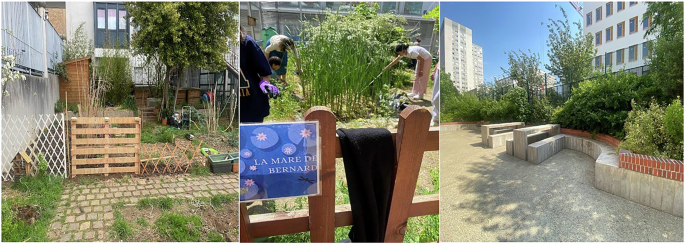
Modalities of the socio-technical production of nature in school grounds
The Paris schoolyard greening project spans several years, engaging a broad range of stakeholders throughout its implementation. The Paris City Council primarily relies on its central (e.g. DEVE) and local (e.g. SEJ) services to design, implement, and manage the project. Each of these three main stages involves a diverse range of stakeholders and services (Fig. 2). Initially, the district council and the school and early childhood affairs division (CASPE) select schoolyards for the project based on two criteria: the level of dilapidation of the schoolyard and, less frequently, existing proposals from the city’s participatory budget. Once a schoolyard and the budget are approved for inclusion, the project moves into a co-design phase involving children, teachers, school staff and various experts, including the Council for Architecture, Urban Planning, and Environment (CAUE), landscape architects from the Public buildings and architecture department (DCPA) and section (SLA) and council services (school affairs, early childhood, cultural affairs, green spaces, youth and sport, etc.).


Diagram of the services involved in the Oasis project in Paris. Source: Cedissia About, 2023.
The CAUE de Paris is offering each school concerned an opportunity to co-design the future playground, the first stage of co-design being with the school’s children. The aim of the workshops with the children is to come up with design recommendations using a project-based approach. Raising awareness of the challenges of climate change and providing references help them to materialise their intuitions and understand the main challenges of a playground. The workshops are then used to establish a diagnosis of the uses of the playground, based on observations and surveys carried out by the children, and to draw up proposals for future developments using scale models.
Then consultation workshops bring together the head of the school, the teachers, the City of Paris, the education officer and the after-school care staff, as well as, if possible, the maintenance staff, the parents, the school doctor and psychologist, the caretakers. These workshops are devoted to report back on the children’s work and make proposals for development scenarios arising from the workshops, to take account of the technical constraints formulated and to finalise, with SLA, the technical layout. In parallel with the consultation workshops, a series of return visits are made to the operational departments of the City of Paris (SLA and CASPE). Recommendations are formulated by the CAUE based on the initial ideas put forward by the children. This collaboration is critical, as around January each year, a two-day project review occurs to discuss the 25 projects slated for the upcoming summer, focusing on technical challenges and assessing the ecological adequacy of the designs.
Despite this collaborative framework, communication can be challenging due to the diversity of involved services, and some stakeholders, such as maintenance staff, teachers, and local community members, often feel overlooked. The DCPA, along with its decentralized services, has been designated by the City Council to coordinate the greening efforts, leveraging its expertise in asset maintenance. However, the green spaces and environment Department (DEVE) faces staffing shortages that limit its capacity to oversee these projects effectively, as the demand for management of public green spaces continues to grow. Consequently, the decision to have the DCPA oversee the Oasis schoolyards necessitates the development of naturalist knowledge and expertise among all involved services.
The management of Oasis schoolyards varies across different schools. Typically, the CASPE assumes responsibility for cleaning and maintenance, serving as the primary contact for schools in case of issues. In some instances, teaching staff actively engage pupils in the daily cleaning of the playground. The DEVE may intervene through its decentralized services when necessary. Effective management requires a broad range of expertise, necessitating collaboration between both central and decentralized services, such as CASPE and SLA. However, challenges arise due to insufficient communication and staffing constraints, which hinder the coherence of the project.
Historically, management issues have been overlooked, though the School Affairs Department (DASCO) is now making efforts to involve DEVE in the management of some schools. Nevertheless, two thirds of the sampled schools remain unclear about whom to contact for support. Additionally, the management of vegetation has not been adequately planned, as school visits indicate that the responsibility for planting cannot fall solely on administrative and teaching staff, who often lack the necessary expertise and face increased workloads. This highlights the critical need to clarify the governance structure for managing Oasis schoolyards, particularly during the operational phase.
Initially, the Oasis school grounds project did not prioritize extensive greening efforts. However, a significant shift occurred after Parisian teams visited their counterparts in Brussels, where the focus was on “bringing nature back into the city” and reconnecting children with their natural environment (as explained by SERP Public-access facilities department). The Paris team including civil servants from the city hall as well as the CAUE was inspired by the extensive transformations in Brussels that emphasized vegetation while still achieving the goal of creating cool areas. They observed that replacing tarmac with permeable materials not only improved the environment but also proved to be more cost-effective: “if you take away the tarmac and replace it, as we had done, with light, draining ground, it improves things. And if you replace it with earth and vegetation, it works even better. And incidentally, it’s cheaper than the materials.” (SERP). As a result, from 2020 onwards, the project specifications have been revised to give priority to more vegetation than in previous years, placing greater emphasis on biodiversity than originally intended, even if, according to the SERP, this is not necessarily easy. NbS are interesting as long as they are related to anthropocentric considerations. In fact, children’s well-being is a key argument used by the City Council to gain support for the transformations from both departments and school staff. As one Oasis project manager from the CAUE explained: ‘It shouldn’t just be an environmental response […] To a certain extent, we did meet the challenges. […] I think that by talking so broadly about children’s well-being, it was, I don’t know if it was marginal, but in any case, it was a clear-sighted move. And it’s also what enabled us to get the schools on board in a big way. Because, if you like, at the beginning a lot of schools will say: “Yes, but it’s a political project”. And we tell them: “No, in fact, it’s also for the pupils, it’s also for the children, it’s also for the citizens of tomorrow”.
Despite this progress, challenges remain due to the limited size of Parisian schoolyards, high pupil density, and the need for space for recreational activities. Following the Brussels visit, the DEVE updated the project guidelines to emphasize landscape design and increase vegetation. However, the greening approach often remains largely ornamental, with plant selection primarily focusing on esthetic preferences, such as flower colors and year-round foliage. Additionally, plant choices are restricted to local, non-toxic species sourced from the city’s nursery, which further limits biodiversity potential.
Comparison of biodiversity in schoolyards and nearby green spaces
Although vegetation was initially given low priority in the transformation of schoolyards, arthropods inventories reveal these areas support diverse communities, although often at lower levels than neighboring green spaces.
A total of 7929 individuals (3681 in schoolyards and 4248 in green spaces), attributed to 442 different morphospecies (280 in schoolyards and 345 in green spaces) and representing 16 orders, were collected and identified. Most individuals belonged to the Hemiptera, including aphids, mealybugs and bedbugs, followed by the Diptera, which encompasses flies, midges, and mosquitoes.
Variability in arthropod abundance was observed across different schoolyards (Fig. 3), with Merlin and Olivier Métra nursery schools hosting the highest numbers of individuals, followed by La Brèche aux Loups primary schools and Guillaume Budé and Courteline secondary schools. The average total arthropod abundance found in schoolyards (230 ± 104 individuals) was statistically no different (Chi², χ²= 0.85, p = 0.36) from that of green spaces (265 ± 138), except for Diptera, whose abundance was significantly higher in green spaces (test post hoc, z.ratio ∞ = –6.74, p < 0.0001).


Name pairs are made up of the first three letters of the school’s name followed by the first three letters of the name of the nearest green space. Data are ordered by increasing abundance in schools. Source: Mélanie Gippet.
Arthropod morphospecies richness varied among schoolyards, with a range of 66 species at Charles Hermite and 29 at Quatre Fils (Fig. 4). Four schoolyards stand out with the highest levels of morphospecies richness: Charles Hermite landscaped in 2018 (first generation of green schoolyards), (Olivier Métra), Budé (second generation, respectively 2021 and 2023) and Courteline (Oasis candidate initiated by the local staff and helped by the City Council).

Name pairs are made up of the first three letters of the school’s name followed by the first three letters of the name of the nearest green space. Data are ordered by increasing number of arthropods in schools. Source: Mélanie Gippet.
On average, schoolyards hosted 44 ± 12 morphospecies, which is significantly lower than the 58 ± 10 morphospecies found in nearby green spaces (Chi², χ² = 14.07, p < 0.001). The disparity in morphospecies richness was particularly pronounced in Diptera, with an average of 25 morphospecies identified in green spaces compared to just 8 in schoolyards (test post hoc), z.ratio ∞ = –8.66, p < 0.0001. At the stratum level, only the herbaceous layer of green spaces shows greater species richness than that of schoolyards (Chi², χ² = 17.13, p < 0.001).
Morphospecies richness positively correlated (Chi², χ² = 20.99, p < 0.0001) with the area of vegetation within the schoolyards, indicating that larger vegetated areas support greater biodiversity. Additionally, richness was associated with the proportion of vegetation surrounding the schoolyards (Chi², χ² = 4.5112, p < 0.034), while the distance from a green space showed no significant impact (Chi², χ² = 1.0721, p < 0.300).
Community composition varies greatly between school grounds and green spaces, and within each category of site. The arthropod communities present in schools and green spaces differ in their composition by more than 70% (ANOSIM, R = 0.25, p = 0.001), mainly because of hemipterans of the Aphididae family, leafhoppers of the Eupteryx genus and ants of the Lasius genus, all of which are more common in schoolyards (in planters or on tarmac) and Chironomidae (a family of Diptera), which are more commonly found in the lawn areas of green spaces.
NbS to reinforce human–nature interactions
Our interviews with teachers and school principals highlighted both a strengthening of the interactions between children and nature, as well as the gradual formation of a broader community interested in biodiversity issues.
The biodiversity dynamic goes hand in hand with landscaping based on NbS. According to some of the school principals and teachers who have observed the project, this approach profoundly transforms schoolyard spaces and the social interactions within them. The diversity of the landscape and ecology of these redesigned schoolyards promote more prosocial and cooperative play by challenging traditional power dynamics. The schoolyards are widely recognized by our interviewees for reducing conflicts as the fragmented nature of the schoolyards encourages less competition from children for a single space. Children disperse into groups with different activities. Previously, the boys occupied most of the space for ball games, while the girls were often confined to the margins. Creating different areas in the playground helps to reduce gender inequalities in the use of space. On another hand, they also create areas that are less visible to supervisors, making it more difficult to observe and manage conflicts in vegetated areas.
In addition, the variety of NbS in schoolyards reinforces the diversity of games and behaviors related to nature. Some of our interviews show that creatures, particularly ants and other insects, play a significant role in children’s games. As one school principal observed: ‘children are often fascinated by ants. I’ve already seen children playing with ant houses in the orchard. Yes, they love it. They’re quite respectful. They don’t crush them or harry them. On the contrary, they make houses and paths !’ These interactions and this wonderment for fauna also apply to plant species, as explained by the school principal in the 11th arrondissement of Paris who described the amazement of children when they dig up potatoes, comparing them to “gold bars.”
Some members of these communities show a long-term commitment, as the school principal in the 11th arrondissement explained: ‘I’ve been involved in this project for about 10 years now. I’ve got my notebook with the vegetable garden plan every year, where I write down what we’re going to sow and plant, and then I write down the names of the classes with the children and what they come to do.’ In some schools, parents contribute to the project, for example by donating plants or making a one-time financial contribution. The sustainability of these initiatives and the growth of planted areas heavily rely on the commitment and personal motivation of the adults involved, whose sensitivity to nature and biodiversity issues varies. Some of them even dedicate their free time to maintain the schoolyards, often with significant help from the maintenance staff, who have had to adapt their work routines and for whom the development of these new schoolyards is a big and physically demanding job. As one maintenance worker remarked, ‘this ground is shit, it doesn’t soak up water and it’s difficult to clean’. However, the motivation to maintain the schoolyards is essential, and unites a diverse group of individuals. For some, this motivation stems from their childhood experiences in natural environments, where they became familiar with nature, through gardening for example. For others, the motivation is linked to their professional background, like the parent we met at Collège Pierre Alviset, who now runs the school’s gardening workshop. Additionally, many are motivated by seeing the deterioration and neglect of the schoolyard and feel a sense of responsibility to restore it. They feel it is both necessary and their responsibility to teach the importance of protecting nature and the environment, particularly in the current context.
However, this contribution is inconsistent, as it relies entirely on the goodwill of parents, as explained by a school principal in the 11th arrondissement, whose school has not received support from either the ERDF or the CAUE: ‘Parents participate indirectly, because we have what are called school cooperatives in the schools […]. And it works with donations from parents, totally voluntary donations from parents, and with that money we can go on outings, for example, and a small part of that money is used to really keep the vegetable garden going, i.e., to buy potting soil, buy seedlings, seeds, that sort of thing.’
link