


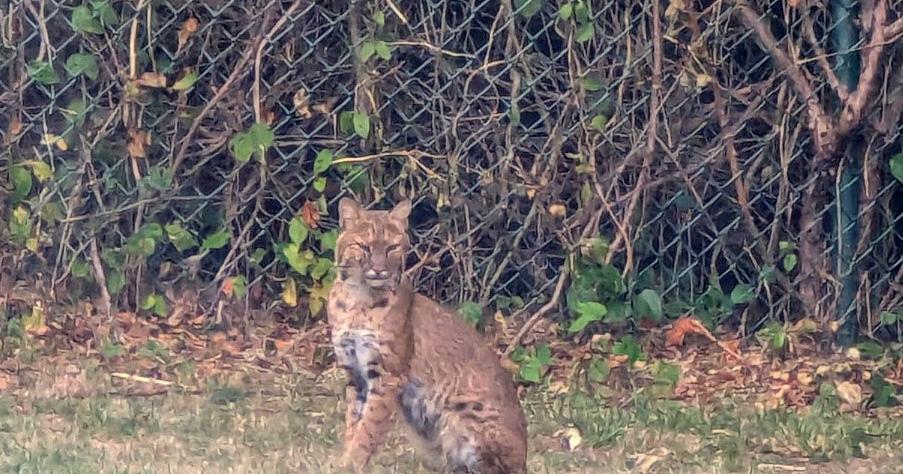
A new statewide project by the University of Rhode Island and state environmental agencies is enlisting help from the public to report sightings of elusive bobcats.
Dubbed the Rhode Island Bobcat Project, researchers at URI have teamed up wit the Rhode Island Department of Environmental Management, the Wildlife Clinic of Rhode Island and local land trusts to support bobcat conservation, promote understanding of their important ecological role, and provide critical data for wildlife management.
The research team has launched a three-pronged approach including camera traps, collaring bobcats with GPS units and collecting science data from residents. For the latter, Rhode Islanders are encouraged to report sightings and submit photographs to help researchers better understand the animals’ movement patterns, habitat use and population dynamics.
“We want people to be excited about seeing bobcats and to understand their importance for biodiversity,” Kathleen Carroll, URI assistant professor of applied quantitative ecology, said. “Tracking them helps us identify broad implications for supporting bobcat populations.”
The effort was inspired by camera trap studies conducted from 2018 to 2023 that found that species like fishers and foxes appear to be in decline, raising concerns about environmental changes, diseases and rodenticide exposure. However, the same study indicated that bobcat populations are stable or increasing.
Carroll and Christopher Hickling, a Ph.D. student in natural resources science, say the bobcats’ increasing presence in the state is a positive development.
“Their presence on the landscape tells us that we’re doing something right,” Hickling said, “because they wouldn’t be here if there wasn’t high biodiversity at lower trophic levels.”
Bobcats, they said, play a critical ecological role in an ecosystem lacking apex predators like wolves and cougars, especially as other species like fishers and foxes decline, because they offer services such as rodent control and disease suppression.
While bobcats tend to avoid human interaction, their reclusive nature has likely allowed them to adapt better than other carnivores to human-dominated landscapes.
Camera trapping, the project’s first task, was scheduled to wrap up in September. DEM biologist Laken Ganoe and Amy Mayer, a URI research associate, initially organized the camera trapping that began in 2018. Together, they placed 320 cameras at 160 locations across the state to monitor mammal species, including bobcats.
While that data is important, community science participation provides additional critical insight to broaden understanding on private lands, especially since most of the initial camera trapping surveys were done on public land. With community cooperation, researchers will be setting traps to safely capture and collar bobcats.
The final component of the research project involves GPS tracking bobcats with radio collars. The GPS units allow for detailed monitoring, helping identify where bobcats rest, hunt and travel and informing recommendations for land management practices that balance human use with wildlife conservation.
“Using the GPS data in conjunction with camera traps and citizen science reports of sightings gives us multiple data sources to learn about this species,” Hickling said. “Being able to gather as much information as possible is extremely helpful.”
Members of the public who allow trapping on their property will be invited to witness the animals being released post-collaring.
A reporting form online at uri.edu/bobcatsurvey will remain open indefinitely, and Rhode Islanders are encouraged to submit information and photographs. For questions, or to receive a sticker with a QR code to the form, contact kathleen.carroll@uri.edu or chickling@uri.edu.
link