


Common method bias test
To address potential common method bias (CMB) in self-reported surveys, Harman’s single-factor test was conducted. Exploratory Factor Analysis (EFA) on 235 valid samples revealed that the variance explained by the first unrotated principal component was 23.968%, well below the 40% threshold, indicating no significant CMB in this study.
Reliability and validity tests
Reliability was assessed using composite reliability (CR) and factor loadings. Validity was evaluated via confirmatory factor analysis (CFA), with convergent validity measured by average variance extracted (AVE) and discriminant validity confirmed by comparing the square roots of AVE values with inter-construct correlations (Tables 3 and 4).
Descriptive statistics
Heterogeneity analysis of five urban parks
This study selected five representative parks in Chengdu distinguished by diverse locations, high popularity, and frequent resident usage. Aggregated statistical analysis of respondents’ mean perception scores for natural environments across these parks revealed (Table 5): Huanhuaxi Park scored highest (M = 5.5636), followed by Donghu Park (M = 5.2679), while the People’s Park (M = 3.7733) and Baihuatan Park (M = 4.6500) registered the lowest scores. These results indicate stronger natural environment perception in Huanhuaxi and Donghu Parks, contrasting with weaker perception in the People’s Park and Baihuatan Parks. The elevated scores for Huanhuaxi and Donghu Parks primarily derive from their extensive green coverage, abundant aquatic landscapes, diverse botanical configurations, and well-preserved ecosystems. Although the People’s Park and Baihuatan Park possess aesthetically pleasing natural environments, their downtown locations necessitate hosting intensive recreational activities (e.g., square dancing, matchmaking events), which diminish respondents’ perception of natural elements. Huanhuaxi Park and Donghu Park scored significantly higher in the evaluation of natural environmental attributes. This advantage is primarily attributable to their substantially larger land area compared to the People’s Park and Baihuatan Park. The expansive green spaces, abundant water features, and diverse vegetation inherent to larger parks inherently foster a stronger perception of natural environments. Conversely, the lower scores for the People’s Park and Baihuatan Park should not be interpreted as reflecting inferior natural beauty. Rather, their central urban location, historically established robust social functions, and high visitor density have consistently positioned them as central hubs for public activities, social interaction, and leisure. Consequently, their pronounced social character largely overshadows their natural attributes. Visitors primarily experience the urban vitality and local cultural atmosphere characteristic of these locations, which consequently attenuates their perception of the natural environment.
Although the natural environment perception scores show notable variations across the five urban parks, a one-way ANOVA was conducted to determine whether these differences attain statistical significance. The analysis revealed statistically significant differences in natural attributes among the five parks (F = 26.176, P < 0.001). Subsequent post-hoc multiple comparisons using LSD method identified pairwise differences as presented in Table 6. The results demonstrate that all pairwise comparisons exhibit statistically significant differences (P < 0.05), except for the following non-significant contrasts: Huanhuaxi Park vs. Wangjiang Park, Huanhuaxi Park vs. Donghu Park, and Donghu Park vs. Wangjiang Park (P > 0.05). This confirms substantial heterogeneity in natural attributes among the five parks, ensuring representative sampling and enhancing the generalizability of research findings. Based on the aforementioned statistical analysis, Huanhuaxi Park, Donghu Park, and Wangjiang Park demonstrate comparable scores in perceived natural attributes, forming a distinct cluster characterized by “prominent natural features.” Conversely, the People’s Park and Baihuatan Park exhibit significantly lower scores than this cluster. For this grouping, visitors’ experiences are predominantly shaped by social activities within the parks. These spaces are perceived as an “urban living room” or “multifunctional plaza”, where their social character overshadows natural attributes. The divergence likely stems from differing design and management paradigms: the first three parks prioritize maintaining and highlighting their “ecological value”, while the latter two emphasize fulfilling citizens diverse and intensive “social activity needs”. The former approach yields higher perceived natural environment scores, whereas the latter—despite serving vital urban functions—objectively diminishes individual perception of “naturalness”.
Means, standard deviations, and correlations are summarized in Table 7.. Significant positive correlations were observed between built and natural environments (r = 0.399, p < 0.01), built environment and restorative effects (r = 0.473, p < 0.01), and natural environment and restorative effects (r = 0.456, p < 0.01). Correlation coefficients indicate that restorative effects (dependent variable) exhibit significantly positive correlations with both independent variables—built environments and natural environments. This establishes the prerequisite foundation for subsequent regression model analysis. Furthermore, neither moderating variable (positive emotion, leisure involvement) shows significant correlation with the dependent variable (restorative effects), nor with either independent variable (built environments, natural environments). This pattern confirms both moderating variables are well-suited for the hypothesized model as they demonstrate the essential independence required for testing moderation effects.
Hypothesis testing
To examine the direct effects of environmental factors on restorative effects, hierarchical Linear regression was employed. In Model 1 (Table 8), restorative effect was regressed on demographic variables (gender, age, education level, monthly income) and leisure behavior traits (leisure frequency, leisure duration).
Regression results indicated non-significant coefficients for gender, age, education level, and monthly income, suggesting demographic characteristics are insufficient to explain restorative effects. Conversely, leisure frequency (β = 0.197, p < 0.01) and leisure duration (β = 0.158, p < 0.05) partially explained restorative effects, with the regression model yielding R²=0.103. The regression equation for Model 1 is expressed as:
Restorative Effect = 4.012–0.2479 × Gender + 0.069 × Age − 0.095 × Education Level − 0.037 × Monthly Income + 0.230 × Leisure Frequency + 0.210 × Leisure Duration.
In Model 2, which added built recreational environment and natural recreational environment as independent variables to Model 1, regression results demonstrated significant positive effects of both built environment (β = 0.309, p < 0.001) and natural environment (β = 0.315, p < 0.001) on restorative effects. The model achieved R²=0.365. These findings confirm the hypothesis that environmental factors positively influence restorative effects. The regression equation for Model 2 is:
Restorative Effect = 1.588 − 0.138 × Gender + 0.024 × Age − 0.083 × Education Level − 0.015 × Monthly Income + 0.205 × Leisure Frequency + 0.112 × Leisure Duration + 0.266 × Built Environment + 0.286 × Natural Environment.
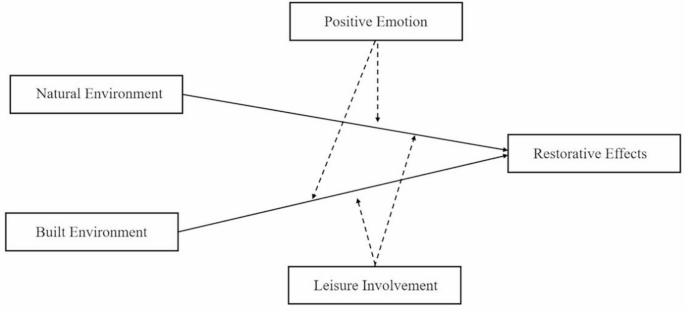
In the moderation analysis, this study first centered the research variables and utilized the PROCESS 3.5 plugin in SPSS to examine the dual moderating effects of positive emotion and leisure involvement at different levels on the relationship between environmental factors (built vs. natural environments) and restorative effects. The analysis employed Model 2 with a 95% confidence interval and 5,000 bootstrap samples. Restorative effects were set as the dependent variable, while positive emotion and leisure involvement served as dual moderators. Leisure frequency and duration were included as control variables.
For built environments, results indicated significant positive moderation by leisure involvement (β = 0.1131, SE = 0.0524, t = 2.1575, p < 0.01) and positive emotion (β = 0.0934, SE = 0.0424, t = 2.2015, p < 0.05). The standardized coefficient comparison revealed that leisure involvement exerted a stronger moderating effect than positive emotion. For natural environments, both positive emotion (β = 0.1201, SE = 0.0554, t = 2.1702, p < 0.05) and leisure involvement (β = 0.1257, SE = 0.0437, t = 2.8773, p < 0.01) showed significant positive moderation, with their effects being comparable in magnitude.
For built environments, simple slope tests revealed that under low positive emotion, leisure involvement significantly moderated the impact of built environments on restorative effects: low involvement (β = 0.1944, p < 0.05), medium involvement (β = 0.3033, p < 0.001), and high involvement (β = 0.4121, p < 0.001). Similar patterns emerged at medium and high positive emotion levels, with progressively stronger effects as moderators increased.
For natural environments, under low positive emotion, leisure involvement showed non-significant moderation at low levels (β = 0.1342, p > 0.05) but significant effects at medium (β = 0.2806, p < 0.001) and high involvement (β = 0.4271, p < 0.001). At higher positive emotion levels, all involvement levels exhibited significant moderation, with the strongest effect observed at high involvement (β = 0.6601, p < 0.001).
The Attention Restoration Theory (ART) posits that prolonged use of directed attention leads to mental fatigue, and that exposure to natural environments can assist individuals in restoring attentional capacity and cognitive functioning. Within the pathway through which the built environment influences restorative effects in this study, the individual focuses more on “what” they are doing rather than “where” they are doing it. Leisure involvement emphasizes the degree of an individual’s active participation in leisure activities; consequently, it exerts a stronger moderating effect than positive emotion in this context. The Stress Recovery Theory (SRT) posits that when individuals experience stressful situations, exposure to natural environments facilitates the restoration of emotional and physiological states, returning the mind and body to a healthier equilibrium. Within the pathway through which the natural environment influences restorative effects in this study, the individual focuses more on “where” they are rather than “what” they are doing. Compared to leisure involvement, positive emotion more effectively facilitates restorative effects arising from natural environmental elements such as greenery, water bodies, soundscapes, and air quality within natural environments. Therefore, its moderating effect is more pronounced.
To summarize, the dual moderating roles of positive emotion and leisure involvement were confirmed. Both variables enhanced the positive effects of built and natural environments on restorative effects, with the magnitude of influence escalating as moderators increased. This underscores the synergistic interplay between psychological states and behavioral engagement in shaping environmental restorative benefits.
link