
Bichronous modes in heritage education for enhancing motivation and learning outcomes via the ARCS model
Overall research framework and hypotheses
The objectives of heritage education can be categorized into three core dimensions: enhancing motivation, cultivating behavioral intentions for heritage preservation, and improving performance outcomes4. Extensive research across diverse educational domains has consistently demonstrated a significant correlation among these three components44,45,46. Given this established framework, the present study aims to investigate whether these associations are similarly applicable within the context of heritage education and to explore the potential influence of different learning modalities on this underlying mechanism.
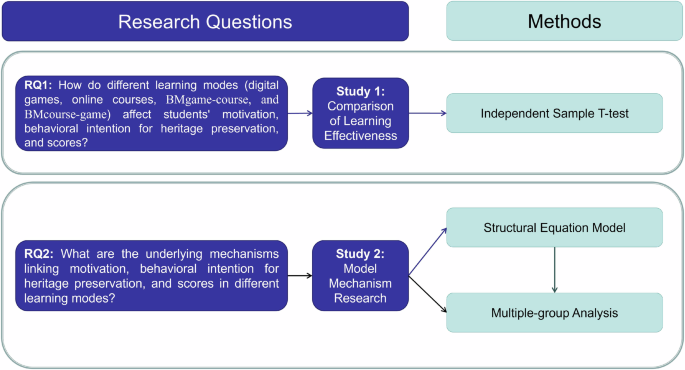
Building upon these considerations, this paper posits the following two research questions (see Fig. 1). RQ1: How do different learning modes (digital games, online courses, BMgame-course, and BMcourse-game) affect students’ motivation, behavioral intention for heritage preservation, and scores? RQ2: What are the underlying mechanisms linking motivation, behavioral intention for heritage preservation, and scores in different learning modes?

Research questions and corresponding data analysis methods.
A structural equation model (SEM) and six hypotheses were proposed to elucidate the underlying mechanism linking motivation, behavioral intention of heritage preservation, and score (see Fig. 2). For the assessment of motivation, the Attention, Relevance, Confidence, Satisfaction (ARCS) model was employed. The ARCS model has been demonstrated to be effective in evaluating students’ motivation in online learning contexts47. It has also yielded notable results in previous heritage education studies48,49.

SEM and hypotheses for RQ2.
The ARCS model is grounded in expectancy-value theory, which posits that human behaviors are evaluative outcomes based on expectations (beliefs), the perceived probability of success (expectancy), and the perceived impact of success (value)50. According to the ARCS model, learning motivation is contingent upon four dynamic perceptual components: attention, relevance, confidence, and satisfaction51. Specifically, attention involves capturing learners’ interest and stimulating their curiosity for learning; relevance entails addressing learners’ personal needs to foster a positive attitude; confidence involves instilling learners with the belief in their ability to succeed and control their success; and satisfaction reinforces accomplishment with rewards (both internal and external).
Furthermore, these four components are categorized into two distinct processes within the ARCS framework: Motivational Processing and Outcome Processing, each serving different roles in learner motivation. Attention, Relevance, and Confidence are classified as Motivational Processing, which helps learners identify achievable performance goals. Satisfaction is considered Outcome Processing, which evaluates the balance between invested effort and final performance52,53. By differentiating between Motivational Processing and Outcome Processing, the ARCS model enables educators to gain a comprehensive overview of the major dimensions of learner motivation and to develop targeted strategies in each area to sustain and enhance motivation.
The behavioral intention of heritage preservation is defined as individuals’ belief that they should take action to comply with the rules of heritage protection and encourage others to participate in heritage preservation efforts. This behavioral intention has been emphasized in numerous international documents. For instance, the Athens Charter (Article 7) recommends that educators “…teach [individuals] to take a greater and more general interest in the protection of these concrete testimonies of all ages of civilization.” Similarly, the Convention on the Value of Cultural Heritage for Society (Faro Convention, Article 12) states that “…[all should be] encouraged to participate in the process of identification, study, interpretation, protection, conservation, and presentation of cultural heritage.”
In the context of heritage education, particularly in environmental education, motivation has been shown to significantly influence behavioral intention. For example, generative motivation, such as educational motivation, has been demonstrated to affect the behavioral intention of environmental protection54. The motivation triggered by the expectation to acquire knowledge can be translated into the behavioral intention of heritage preservation. Thus, hypothesis 1 (ARCS Model -Low effort behavioral intention) and hypothesis 2 (ARCS Model -High-effort behavioral intention) are proposed.
Motivation is also likely to influence students’ scores in heritage knowledge. Heritage knowledge refers to the use of heritage as a tool to enhance learning outcomes55, such as facilitating the development of historical thinking and consciousness. Empirical evidence has demonstrated the impact of the ARCS model on scores56. Additionally, a greater understanding of heritage knowledge has been shown to enhance awareness of the value of cultural heritage protection57. Thus, hypothesis 3 (ARCS Model -Score) is proposed.
In the Theory of Motivation, Volition, and Performance (MVP), motivational processing (ARC) is theorized to impact the outcome processing (S), a relationship that has been empirically validate58. Students’ heritage knowledge and behavioral intention for heritage preservation can be enhanced through age- and level-appropriate instructional methods59. Consequently, higher levels of student satisfaction with their learning experiences are likely to improve both their performance and behavioral intention for heritage preservation. Therefore, satisfaction is proposed to mediate this relationship, leading to hypotheses 4, 5, and 6.
Measurements
Measurements in this study consisted of three components: the ARCS motivational scale, the behavioral intention of heritage preservation scale, and knowledge questions. The original and modified scales were translated into Chinese, adhering strictly to the “Back-Translation” standard60. See Table S1 (Supplementary Information) for the scales.
In this study, the motivational scale was adapted from Keller’s Instructional Materials Motivation Survey (IMMS) and the ARCS literature61. Fourteen items assessed motivational processing (attention, relevance, confidence), and four items assessed outcome processing (satisfaction). The questionnaire employed a five-point Likert scale, where 1 corresponded to “strongly disagree” and 5 corresponded to “strongly agree.”
Four 5-items measured attention which was adapted from Huang et al. 58 and Tsai & Liao62 to measure the level of attention of students. Example questions such as “The content is eye-catching”. The Cronbach’s α coefficient of the scale was 0.833. Relevance comprised six 5-items, which were adapted from Martí-Parreño et al. 63 and Ucar & Kumtepe64 to measure the level of relevance of students. Example questions such as “ The content is relevant to my interests”. The Cronbach’s α coefficient of the scale was 0.879. Confidence consisted of four 5-items, which were adapted from Huang et al. 58 and Tsai & Liao62 to measure the level of confidence of students. The scales were negatively phrased and rated in reverse. Example questions such as “It was more difficult to understand than I would like for it to be”. The Cronbach’s α coefficient of the scale was 0.806. For outcome processing, four 5-items measured satisfaction. The scales were adapted from Tsai & Liao62 to measure the level of satisfaction of students. Example questions such as “The feedback helped me feel rewarded for my effort”. The Cronbach’s α coefficient of the scale was 0.830.
The Environmental Responsibility Scale is often used in the education area to assess individuals’ pro-environmental behavioral intention65. The scales for measuring students’ behavioral intentions of heritage preservation were adapted from the instruments developed by Cheng et al. 66, Gursoy et al. 67, Ramkissoon et al. 68, and Wang et al. 69. The behavioral intention of heritage preservation is divided into low and high effort behavioral intention. Four 5-items pertained to low effort behavioral intention of students’ heritage preservation, in which the example question includes “I will read the reports or books about porcelain conservation and craft inheritance”. The Cronbach’s α coefficient of the scale was 0.830. High-effort behavioral intention used four 5-items to measure the high level of students’ heritage preservation. The example question includes “I will write letters in support of porcelain protection”. The Cronbach’s α coefficient of the scale was 0.844.
The students’ test scores were evaluated through a set of 30 single-choice questions, each allocated a maximum of 1 point, designed to assess their acquisition of two primary categories of knowledge: declarative knowledge and procedural knowledge70,71. The total possible score was 30 points. Declarative knowledge encompassed facts about porcelain, kiln sites, and handicraft types. For example, one question was: “In which dynasty was the blue-and-white porcelain of Jingdezhen kiln first fired? A. Song Dynasty B. Yuan Dynasty C. Ming Dynasty D. Qing Dynasty.” Procedural knowledge pertained to the processes of porcelain making and the handling of special conditions. An example question was: “How was the ancient plum bottle glazed? A. By dipping B. By pouring C. By brushing D. By spraying.” The Cronbach’s α of the scores at different times was 0.801, indicating that the questionnaires were reliable. See Supplementary Information (Section 1, Tables S2–S4) for other reliability indexes. The content of the questionnaires in the three tests was identical, but the sequence varied. Since the terminology of knowledge was taught in Chinese, the original items were developed by four Chinese researchers and then translated into English by another bilingual researcher.
The porcelain heritage digital game and online courses
Ancient porcelain occupies a pivotal position in China’s cultural heritage, epitomizing the unique history of the global handicraft industry. However, modern kilns encounter significant challenges in replicating the ancient porcelain manufacturing process. Moreover, the complexity of the porcelain production process makes it difficult for students to fully comprehend through traditional oral teaching alone. To address these issues, a porcelain heritage digital game and a series of online courses were developed and subsequently integrated into cultural heritage education programs.
The porcelain heritage digital game was meticulously constructed to replicate ancient porcelain-producing equipment and processes. It was designed based on a comprehensive synthesis of existing knowledge, including historical documents, archeological findings, and the latest research. As illustrated in Fig. 3, the game simulates the entire porcelain production process, encompassing material mining, preparation, molding, decoration, and firing. Throughout this process, students are empowered to make independent choices, leading to varied outcomes (see Fig. 4a, b). Subsequently, a virtual craftsman provides relevant explanations. For example, students are required to judge the kiln temperature by observing samples and determine the optimal time to cease firing (see Fig. 4c, d). These decisions result in the creation of different porcelain products. In summary, the porcelain heritage digital game is anticipated to serve as an effective tool to enhance students’ learning motivation and, in turn, influence their behavioral intentions regarding the preservation of porcelain heritage.

The structure of the porcelain heritage digital game.

a Mining interface with raw materials and a cart for collection. Students can drag porcelain-making raw materials into the cart. After dragging correct or incorrect materials, the virtual craftsman prompts and explains. b Crushing interface showing tools and assembly instructions. Students must assemble and start the water-powered trip hammer to crush raw materials. c Firing interface with kiln controls and a temperature gauge. Students need to adjust the kiln temperature to fire porcelain. d Fining interface for glazing color comparison. Students observe sample colors to determine heat control during firing. Throughout these steps, students complete tasks independently but can seek hints from the virtual craftsman when needed.
A series of online courses was developed, comprising 12 sessions: one introductory session, three sessions dedicated to the typical kiln-making technology of the Song Dynasty, five sessions focused on the typical kiln-making technology of the Yuan Dynasty, and three sessions covering the typical kiln-making technology of the Ming and Qing Dynasties. For this experiment, the introductory session and the Jingdezhen Kiln porcelain-making technology were selected for testing, encompassing a total of four lessons (see Fig. 5). The introduction concentrated on the fundamental process of porcelain-making in ancient China. The Jingdezhen Kiln porcelain-making technology course encompassed three distinct segments of different porcelain products: raw material collection and processing, molding, and firing. The content of the online courses was delivered in a variety of formats, including text, images, GIFs, and videos, complemented by teachers’ online explanations.

a Material preparation steps, including shaping clay into a lotus form and making Dun. The teacher explains clay preparation and kneading techniques. b Molding process combining historical records and modern demonstrations. The teacher explains porcelain formation using ancient literature and videos of intangible cultural heritage inheritors. c Firing process showing temperature effects and kiln usage. The teacher links glaze color to firing temperature using ancient records and specimens from intangible cultural heritage practices.
In summary, both the digital game and the online courses share certain similarities and differences. The digital game offers a more enjoyable experience, with a specific focus on a typical artifact and more detailed procedural knowledge. Conversely, the online courses provide a more comprehensive, systematic, and in-depth knowledge base, albeit with a more specialized focus.
Participants and procedure
Heritage education addresses diverse audiences, including students of various ages72, community residents73, and tourists. While research has extensively covered heritage education in primary and secondary schools6,74, higher education in this field has gained relatively less attention75,76. Nevertheless, examining heritage education for college students is highly important for three key reasons. First, strengthening the university-level education for students majoring in cultural heritage and related disciplines is crucial, as it equips them with the expertise and professional skills needed for careers in heritage conservation and management8. Second, the complex and interdisciplinary nature of heritage knowledge requires advanced learning capabilities, making college students well-suited to grasp its intricacies. Third, from a social communication perspective, college students play a key role in spreading heritage knowledge and conservation awareness across society.
Based on these considerations, the study selected college students as participants and applied the following selection criteria. First, undergraduate students currently enrolled in cultural heritage, archeology, history, art, education, Chinese language and literature, or related disciplines were chosen. These students possess foundational knowledge of and show interest in heritage education, which enables them to engage effectively with the research content. Second, participants were required to have basic computer skills and access to online learning resources. Given that the research was conducted entirely online and necessitated independent task completion, these skills were essential. Third, priority was given to students with no prior experience in similar heritage education research to ensure the purity of the data.
For sampling, the study employed convenience sampling. Collaborating with universities in Tianjin, Shandong, Henan, and Jiangxi, the research targeted undergraduate students from various regions of China. Students who volunteered after being informed of the research purpose and requirements were included in the experiment. Each participant received a 20-yuan reward upon completing the experiment to compensate for their time and effort. The experiment was conducted online from September to November 2024.
In summary, selecting undergraduate students as participants aligns with the research goals of this heritage education study. Their relative homogeneity facilitates result comparison and analysis. Additionally, the geographic diversity of the selected universities enhances the applicability and representativeness of the research findings.
As illustrated in Fig. 6, the students were randomly divided into two experimental groups. Initially, both groups were introduced to BMs and questionnaire completion. Over the six-week period, both groups underwent BMs in distinct sequences. In the Group BMcourse-game, students first completed the initial questionnaire. They then participated in four weeks of synchronous online courses, each 30-min session conducted under the instructor’s guidance. Upon completing the online courses, students filled out the second questionnaire. This was followed by a two-week period of asynchronous digital game activities, during which students could learn at their own pace. Finally, students completed the third questionnaire.

The procedure of this study.
Correspondingly, in the Group BMgame-course, students also completed the first questionnaire before the experiment. They then engaged in digital games for two weeks, following the same rules as the Group BMcourse-game. After completing the digital games, students filled out the second questionnaire. This was followed by four weeks of synchronous online courses. Finally, students completed the third questionnaire.
Throughout the research process, strict adherence to the local university’s code of research ethics was maintained. Given that the study exclusively involved adult participants over the age of 18, formal approval from the local ethical committee was deemed unnecessary. Prior to participation, all subjects were provided with comprehensive information regarding the purpose of the research, the principles of research ethics, and the measures ensuring privacy and confidentiality. Informed consent was subsequently obtained from each participant.
The final sample included 349 students. After deleting observations with missing values, the valid sample comprised 336 students, including 174 in Group 1 (51.78%) and 162 in Group 2 (48.21%). The sample consisted of 75 males (22.3%) and 261 females (77.7%). The mean age of the sample was 20.46 years (SD = 1.403). Baseline analysis showed no significant differences in gender, age, initial score, and low and high effort behavioral intention (Tables S5–S7, Supplementary Information).
Analysis methods
SPSS26.0 and AMOS24.0 were employed for statistical analysis in this study. Firstly, Harman’s single-factor test was used to evaluate common method bias. Confirmatory factor analysis, composite reliabilities, and average variance were utilized to assess scale reliability and construct validity.
Guided by the research questions, the data analysis process comprised two parts (see Fig. 1). To address the first research question, an independent sample T-test was conducted to evaluate the effects of different learning modes on motivation, behavioral intentions, and scores.
For the second research question, SEM and multiple-group analysis were employed to analyze the relationships among variables. The model investigated the total, direct, and indirect effects of motivation on behavioral intention and score. Model fit was assessed using the root-mean-square error of approximation (RMSEA), the goodness-of-fit index (GFI), the normed fit index (NFI), the comparative fit index (CFI), and the Tucker-Lewis index (TLI). At last, multiple-group analysis was employed to examine the mechanism of SEM in different learning modes for the second research question. Model fit was assessed with the NFI and the incremental fit index (IFI).
The rationale for using SEM and multiple-group analysis aligns with the second research question. SEM is a comprehensive statistical method that analyzes complex relationships among multiple variables within a unified framework. It is particularly suitable for models incorporating both latent and observed variables77. In this study, SEM is employed to investigate the relationships among students’ motivation, satisfaction, behavioral intention, and score. The methodology of SEM comprises two integral parts: the measurement model and the structural model. The measurement model delineates the relationship between latent variables and their observed indicators, for example, the latent variable of satisfaction is reflected through multiple specific observed indicators, such as questionnaire items. The structural model, on the other hand, describes the causal relationships between latent variables, such as the influence of motivation on satisfaction and the subsequent effect of satisfaction on behavioral intention. and the structural model, which describes the causal paths between latent variables. The application of SEM can estimate the magnitude and significance of path coefficients, thereby uncovering the direct, indirect, and total effects between variables.
Multiple-group analysis, an extension of structural equation modeling (SEM), divides the sample into distinct subgroups based on a designated grouping variable. It constructs identical SEM models for each subgroup and compares model parameters across these subgroups78. By systematically testing configural, metric, scalar invariance, and structural covariance invariance, this method elucidates similarities and differences in latent variable relationships79. In this study, multiple-group analysis is employed to investigate whether the mediating role of satisfaction in the relationship between motivation and behavioral intentions remains consistent across the two learning modes (BMgame-course and BMcourse-game).
link