
Commercial color impact on traditional heritage features in Suzhou Shiquan historic district
Research area
Located in Gusu District, Suzhou City, Jiangsu Province, China, Shiquan Street is a street with a long history and rich cultural heritage46. It not only embodies rich historic and cultural heritage, but also embraces numerous representative historic buildings, showcasing the traditional water-town features of Suzhou and the cultural characteristics of Jiangnan (Fig. 2).

The photographs shown in these images were taken by the author himself with a hand-held camera. All other images are acknowledged by the author.
From the perspective of architectural and cultural heritage value, Shiquan Street is not only a commercial district, but also renowned for its profound cultural heritage. Therefore, Shiquan Street has typical representativeness. In history, this place has been a gathering place for numerous celebrities, leaving behind a rich heritage. There are also former residences of some important historical figures in the district, such as the former residence of Chiang Ching-kuo (the second son of Chiang Kai-shek, the highest commander of the Chinese War Zone during World War II), the former residence of Li Genyuan (a former politician and military strategist of the Republic of China), the former residence of Shen Deqian (a famous official of the Qing Dynasty in China), and Peng Dingqiu (a famous literary figure of the Qing Dynasty in China). Meanwhile, the famous Chinese Jiangnan garden “Master-of-Nets (Wangshi) Garden” is also located within Shiquan Street. Thus, Shiquan Street should have been a district that embodies the traditional features of the Jiangnan region in China.
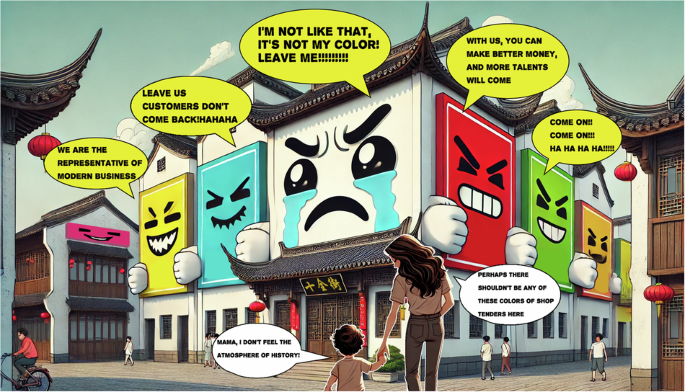
However, in the revitalization process of Shiquan Street, the introduction of a large number of modern commercial elements such as cafes, restaurants, and various shops has significantly changed the color features of the district. The traditional color system of Jiangnan, which was originally dominated by simple gray tiles, white walls, and bluestone roads of low saturation, has gradually been replaced by bright commercial store signs of high contrast (Fig. 3). Various commercialized store signboards have broken the harmonious color tone and visual continuity of the historic district, resulting in heterogeneity and fragmentation of the overall color features. Shiquan Street has been a historic and cultural district, and its traditional colors not only carry regional cultural memories, but also serve as an important source of identity and cultural belonging for the district. The strong involvement of modern commercial colors has visually weakened the historic features of the district and reduced the uniqueness of culture, resulting in the loss of traditional color language. Meanwhile, the lack of color coordination has exacerbated the divergence between culture and commerce, leading to a homogenization of the overall style of the district and the loss of its unique visual and cultural charm.

The photographs shown in these images were taken by the author himself with a hand-held camera. All other images are acknowledged by the author.
Overall research process
In this study, the colors of historic buildings located in the district is used as the carrier of the traditional color features of the district, and commercial shop signs, storefronts, and other commercial attachments attached to the historic buildings in the district are seen as the expression medium of commercial element colors. The original street view samples required for further research are the street view photos of Shiquan Street in Suzhou. The main purpose of this data collection is to obtain visual samples that could accurately reflect the historic and cultural characteristics of the district.
Computer vision and image processing technology play a key role in this process, which can achieve precise recognition and classification of visual elements in street view images through semantic segmentation of samples. Specifically, the process involves utilizing open-source datasets for semantic segmentation and color correction of images to ensure that each visual element could be accurately identified and classified. Afterwards, various color clustering techniques are applied to classify and analyze different color schemes and patterns for various samples, so as to provide technical support for research conclusions. The integration of these samples with computer vision technology aims to gain a more accurate and comprehensive understanding of the visual features of the historic district, providing a foundation for further exploration of the protection and enhancement of cultural heritage in urban environments. The specific steps and process are shown in Fig. 4.

Data source
In the data source for subjective dimensions, to gain a deeper understanding of the public’s perception of the commercial colors in Shiquan Street, Suzhou, this study designed the “Survey on Commercial Element Colors and Cultural Perception in Shiquan Street, Suzhou.” The questionnaire, based on the Likert scale, uses a five-point rating system and covers various aspects such as the overall color perception of Shiquan Street, the experience of historical and cultural atmosphere, and the coordination of commercial element colors. The survey was conducted on Shiquan Street in Suzhou, and a total of 950 questionnaires were collected. Among them, 935 were valid. The respondent group includes local residents, visitors, and local students, aiming to cover a diverse range of social groups to ensure the comprehensiveness and representativeness of the data.
In the objective dimension data source, the entire study mainly uses 3 kinds of open-source data, namely road data, POI (Point of Interest) data, and street view photos. Among them, POI data is used to discover and verify the questions that have been raised. The street view photos serve as the basis for the entire study.
The street view photo samples are collected using the Open Street Map platform ( ArcGIS and Baidu API ( which are used to achieve extensive and precise collection of existing street view photo samples. This method can provide more efficient and accurate batch data collection in the collection of a large number of historic district samples. Firstly, the Open Street Map platform was used to get the road data of Shiquan Street in Suzhou, and its built-in WGS84 coordinate system was directly matched with ArcGIS 10.6 geographic information system without the need for coordinate correction. After inputting the road line data into the ArcGIS 10.6 platform, the roads were segmented into line segments, and street view sampling points were set every 20 m. The 20-m collection interval allows for the inclusion of more commercial elements (such as store signs, billboards, etc.) during image collection, preventing the omission of any details that may impact the color esthetics. By using a denser image collection, we can ensure that the visual features of each block are fully captured, especially small-scale commercial elements, which are crucial for accurately analyzing color harmony. Adjustments were made according to the actual situation, and finally, 105 valid coordinate points were determined as the basis for further sample extraction (Fig. 5).

Schematic diagram of sampling points and buffer construction.
Next, Python script was used to get street view photos from Baidu, obtaining a batch of street view photo samples of Shiquan Street based on the 105 valid coordinate points. In order to more clearly identify the building information in street view photos and use it for following semantic segmentation, the shooting angle of all street view photos was uniformly set to an elevation angle of 20°, and 2 sets of photos (i.e., 90° and 270°) were obtained from the left and right sides of the road, respectively. After screening and removing invalid samples, a total of 807 valid street view photo samples were obtained, among which a total of 518 samples were used for the preliminary problem searching (all of which are the street view data of Shiquan Street of 2015, 2017, 2019, 2021, 2023, and 2024), and 289 street view photo samples were used for the overall experiment (the latest data of 2024). It is worth noting that some samples cannot be processed due to lack of updates. Therefore, photos were taken using handheld cameras to capture some missing nodes in order to improve the sample quality of the core experiment. In this section, in order to conduct more accurate analysis on the commercialized colors of Shiquan Street, the 2024 street view photos of Shiquan Street used for core analysis were divided into 8 standard segments, namely the south and north segments of Fengmenqiao-Xiangwang Road (S01, N01), the south and north segments of Xiangwang Road-Daichengqiao Road (S02, N02), the south and north segments of Daichengqiao Road-Wuqueqiao Road (S03, N03), and the south and north segments of Wuqueqiao Road-Renmin Road (S04, N04) (Fig. 6).

Schematic diagram of standard segments.
The acquisition of POI data mainly relies on “eazypoi” to get the map data from Baidu. In the Baidu Maps platform, POI data is usually divided into 6 categories: industry, food, accommodation, medicine, catering, and lifestyle services. Among them, the major categories that reflect commercial elements are food, accommodation, catering, and lifestyle. Therefore, these 4 categories were classified into POI points reflecting commercial elements. Then, the 105 coordinate points obtained from the above were used for coupled grasping, that is, using each coordinate point as the center to draw a circle with a radius of 50 m. The 105 coordinate points were connected to form the area of shops along Shiquan Street in a range of 20 m on both sides, with the road as the centerline. The POI coordinate points were extracted within the area to obtain the information data of commercial shops along Shiquan Street in Suzhou (Fig. 5). This data was used in the early stage of problem determination.
Problem determination stage
At this stage, the first hypothesis that needed to be determined was whether the commercial element colors within the historic district would become richer with the increase of the number of commercial shops, so calculation was made to the number of various business formats in this stage. In this stage, we mainly used the POI interest point data obtained in the previous 5 years of 2015, 2017, 2019, 2021, and 2023 of Shiquan Street, as well as the corresponding street view photos for each year, to verify our hypothesis.
Calculation of estimated kernel density values
Firstly, in order to visually observe the number of stores in recent years, kernel density analysis was conducted on these POI data points on the ArcGIS 10.6 platform47.
The calculation formula is as follows:
$$\hat{f}(x)=\frac{1}{n}\mathop{\sum }\limits_{i=1}^{n}\frac{1}{{h}^{2}}K\left(\frac{d(x,{x}_{i})}{h}\right)$$
(1)
Where, n is the number of sample points; xi is the number of individual sample points; h is the bandwidth that determines the smoothness of the estimation; K is the kernel function used to weight the contribution of each point; d(x, xi) is the distance from the center of the grid to the sample point (x, xi).
Calculation of global Moran’s index
Secondly, a global Moran’s index calculation was conducted on the POI data from previous years on the ArcGIS 10.6 platform. Moran’s index is a statistical indicator used to measure spatial autocorrelation and determine whether geographic data tends to aggregate or disperse in space48. It detects the spatial correlation of variables by analyzing the similarity between geographic data points.
The calculation formula is as follows:
$${\rm{I}}=\frac{n}{W}.\frac{{\sum }_{i=1}^{n}{\sum }_{j=1}^{n}{w}_{ij}({x}_{i}-\overline{x})({x}_{j}-\overline{x})}{{\sum }_{i=1}^{n}{({x}_{i}-\overline{x})}^{2}}$$
(2)
Where, n is the number of observed values; xi and xj are the observed values in the geographic spatial dataset; \(\overline{x}\) is the average of all observed values; wij is the spatial weight between positions i and j; W is the sum of all spatial weights. The range of Moran’s index is usually between −1 and 1. When the Moran’s index approaches 1, it indicates that there is positive autocorrelation in spatial data, meaning that the attribute values of adjacent regions are similar and show a clustering trend. When the Moran’s index approaches −1, it indicates that there is negative autocorrelation in spatial data, meaning that there is a large difference in attribute values between adjacent regions, showing a dispersed trend. When the Moran’s index approaches 0, it indicates that the spatial data has no obvious autocorrelation and the data distribution is random. Therefore, conducting Moran’s index analysis on the annual POI data can provide a clearer understanding of whether the commercial shops on Shiquan Street are increasing and gathering year by year.
Color richness calculation of the frame
Finally, the street view photos over the years were input into Matlab to measure color richness, and the color richness was evaluated by referring to the RGB color space image evaluation method proposed by Hasler et al.49 and Jiang et al.50.
The calculation formula is as follows:
$$\begin{array}{l}{r}_{g}=R-G\\ {y}_{b}=\frac{1}{2}(R+G)-B\end{array}$$
(3)
Where, R, G, and B respectively represent the red, green, and blue colors; rj is the difference between the red and green channels; yb is the difference between the sum of 1/2 of the red and green channel values and the blue channel value. Next was followed by calculating the standard deviation \({\sigma }_{{{\rm{rgy}}}_{{\rm{b}}}}\) and mean\({\mu }_{{{\rm{rgy}}}_{{\rm{b}}}}\).
The calculation formula is as follows:
$$\begin{array}{l}{\sigma }_{{{\rm{rgy}}}_{{\rm{b}}}}=\sqrt{{\sigma }_{{\rm{rg}}}^{2}+{\sigma }_{{\rm{yb}}}^{2}}\\ {\mu }_{{{\rm{rgy}}}_{{\rm{b}}}}=\sqrt{{\mu }_{{\rm{rg}}}^{2}+{\mu }_{{\rm{yb}}}^{2}}\end{array}$$
(4)
Finally, the color richness C value of the street view photo samples was calculated and the color richness for every years was selected51.
The calculation formula is as follows:
$$C={\sigma }_{{{\rm{rgy}}}_{{\rm{b}}}}+0.3\times {\mu }_{{{\rm{rgy}}}_{{\rm{b}}}}$$
(5)
At this point, it was able to verify whether the commercialized colors of Shiquan Street became richer with the increase of numbers by combining the visualization of kernel density analysis of street view photos over the years, the aggregation/dispersion results of Moran’s index, and the evaluation results of color richness, in order to proceed with the following experiment.
Research method for analyzing the subjective perception of commercial colors
In the subjective perception of commercial colors section, we conducted a questionnaire survey to explore the public’s attitudes toward the commercial element colors in Shiquan Street, as well as the correlation with objective evaluation results. The questionnaire, titled “Survey on Commercial Element Colors and Cultural Perception in Shiquan Street, Suzhou,” was designed using the Likert scale, assessing the commercial element colors of Shiquan Street in Suzhou across two dimensions: color-related and culture-related, with five aspects: Color Coordination, Color Homogenization, Color Acceptance, Cultural Depth, and Cultural Appeal. Among these, the independent variables are Color Coordination, Color Homogenization, and Color Acceptance (color-related dimension), while the dependent variables are Cultural Depth and Cultural Appeal (culture-related dimension). Respondents selected their opinions based on five indicators: Strongly Disagree, Disagree, Neutral, Agree, and Strongly Agree. All data were analyzed using SPSS 21.0. The specific content of the questionnaire survey is provided in the appendix.
Descriptive Statistics:Descriptive statistics is an important method for conducting preliminary analysis of survey data and plays a key role in evaluating the subjective perception of commercial colors in Shiquan Street, Suzhou. By calculating indicators such as frequency, percentage, mean, and standard deviation, descriptive statistics comprehensively summarizes the basic characteristics of the sample data, laying a solid foundation for further exploration of the correlation between subjective perception of commercial colors and objective evaluation results. Specifically, frequency and percentage reveal the distribution of respondents’ choices across five dimensions (Color Coordination, Color Homogenization, Color Acceptance, Cultural Depth, Cultural Appeal), visually presenting the tendencies of different options. The mean quantifies the central tendency of respondents’ overall attitudes, providing a core basis for evaluating the commercial element colors of Shiquan Street, Suzhou. The standard deviation reflects the consistency and dispersion of respondents’ opinions within each dimension, offering support for assessing the stability and interpretability of the data. By utilizing SPSS 21.0 analysis tools, descriptive statistics not only provides foundational data for analyzing the relationship between the dependent variables (Cultural Depth, Cultural Appeal) and independent variables (Color Coordination, Color Homogenization, Color Acceptance), but also offers theoretical support for the interpretation of results from subsequent factor analysis and path analysis.
Reliability Analysis:Cronbach’s Alpha: Cronbach’s Alpha coefficient is a statistical measure used to assess the internal consistency of a scale or questionnaire. Its value ranges from 0 to 1, with higher values indicating better internal consistency, meaning the items within the scale or questionnaire are more strongly correlated and the measurement reliability is higher. For example, when the Cronbach’s Alpha coefficient is close to 1, it suggests that the items in the scale are highly correlated and can effectively measure the same underlying concept or trait. Generally, a Cronbach’s Alpha coefficient greater than 0.7 indicates good internal consistency, while a value above 0.8 indicates excellent internal consistency.
KMO Value (Kaiser-Meyer-Olkin Measure of Sampling Adequacy): The KMO value is a statistic used to test whether the partial correlations between variables are suitable for factor analysis. The KMO value ranges from 0 to 1, with values greater than 0.7 generally indicating that the data is suitable for factor analysis. The closer the KMO value is to 1, the more common factors exist between the variables, making the data more suitable for factor analysis.
Factor Analysis:Factor analysis in this study is used to explore the underlying structure of the questionnaire data related to the subjective perception of commercial colors in Shiquan Street, Suzhou, providing a scientific basis for optimizing the research model. By extracting the core factors from the five dimensions of the questionnaire, factor analysis can reveal the latent relationships between variables and reduce the complexity of the data into a few comprehensive factors for further analysis. Specifically, factor analysis helps identify which dimensions play a key role in the evaluation of commercial color perception, cultural depth, and cultural appeal, offering theoretical support for modeling the relationship between dependent and independent variables in the study. Additionally, by rotating the factor structure, this study can more clearly interpret the contribution of each factor, laying a solid foundation for path analysis and result interpretation. The application of factor analysis not only enhances the scientific rigor of the research model but also provides actionable theoretical guidance for optimizing the management of commercial colors in historical districts.
Correlation Analysis:In this study, correlation analysis is used to explore the relationships between the various dimensions of subjective perception of commercial elements’ colors in Shiquan Street, Suzhou, providing data support for further path analysis. By calculating the correlation coefficients, we assess the strength and direction of the linear relationships between the independent variables (Color Coordination, Color Homogenization, Color Acceptance) and the dependent variables (Cultural Depth, Cultural Appeal). When the correlation coefficient is positive (0 < r ≤ 1), it indicates a positive influence of the independent variable on the dependent variable; when the correlation coefficient is negative (−1 ≤ r < 0), it shows a negative relationship between the two variables; if r is close to 0, it suggests a weak linear relationship between them. Correlation analysis not only reveals the associations between different dimensions but also provides preliminary evidence for understanding how subjective perceptions of commercial colors influence the cultural depth and appeal of historical districts.
Path Analysis:In this study, path analysis is used to investigate the direct and indirect effects of subjective perceptions of commercial element colors (Color Coordination, Color Homogenization, Color Acceptance) on Cultural Depth and Cultural Appeal in Shiquan Street, Suzhou. By constructing a path model, we calculate the path coefficients between variables to quantify the strength and direction of the influence of independent variables on dependent variables. Specifically, the path analysis reveals how the coordination and acceptance of commercial colors directly impact cultural appeal, while color homogenization may indirectly affect cultural depth through mediating variables. This analysis not only helps to verify the inherent relationships between subjective perception dimensions and the cultural characteristics of historical districts but also provides theoretical support for optimizing commercial color design.
Objective evaluation of commercial color based on computer methods
Mask2former image semantic segmentation technology based on VIT model:In the processing stage of the latest street view photo samples of Shiquan Street, street view photos were used to segment the required research objects, namely buildings (not including commercial elements) and commercial elements (including signboards, store facades). Therefore, a novel semantic segmentation network was integrated to achieve precise segmentation of commercial elements, which achieved the goal of semantic segmentation by using the mask2former model based on the VIT model proposed by Dosovitskiy et al. (Fig. 7)52. VIT can segment an image into fixed sized blocks (e.g., 16 × 16 pixels), each of which is unfolded into a one-dimensional vector and forms an input sequence through position encoding. These input sequences are processed through a multi-layer transformer encoder, each encoder layer contains a multi-head self-attention mechanism and a feedforward neural network, and the expression ability and stability of the model are enhanced through layer normalization and residual connections53. In terms of training strategy, models pre-trained on large-scale datasets such as ImageNet were used. Then, fine tuning was conducted on specific task datasets (such as the ADE20k Street View database), to improve its segmentation accuracy on street view data. When the building category and trade name category from the ade20k dataset were used for building and trademark recognition image segmentation in Mask2Former, the segmentation performance was poor. So, the Billboard category from the massive Mapillary Vistas Dataset was combined for mask merging to optimize the shortages, which removed impurity masks, further improving the accuracy of semantic segmentation. Compared to commonly used semantic segmentation techniques such as Deeplab and Segnet, the semantic segmentation technique proposed in this study can better understand and segment details in images, which accurately segment the needed research objects.

Mask2Former semantic segmentation model based on VIT.
Color space analysis technology based on Mtalab platform:In previous studies, most measurements of color harmony were simply based on the Euclidean distance in the HSV color space, but this method has certain errors. In this study, the standard (CIEDE2000) issued by the International CIE in 2000 was introduced to calculate the color difference between two points, and all the color particles required for the study were converted into the CIELAB color space. The CIEDE2000 color difference formula (commonly referred to as ΔE) is an advanced color difference assessment method that considers multiple visual factors to provide color difference measurements that are more in line with human color perception54. This formula is relatively complex, including considerations for adjusting brightness, color saturation and hue difference, as well as hue compression.
The calculation formula is as follows:
Step 1: Calculate the distance between 2 color particles C1 and C2. Every color particle is represented by L*, a*, and b* in the CIELAB color space. Therefore, it needs to calculate the color saturation C* and hue angle h’ of each color particle:
$$\begin{array}{l}{C}_{1}^{\ast }=\sqrt{{({a}_{1}^{\ast })}^{2}+{({b}_{1}^{\ast })}^{2}}\\ {C}_{2}^{\ast }=\sqrt{{({a}_{2}^{\ast })}^{2}+{({b}_{2}^{\ast })}^{2}}\\ {h}_{1}^{\text{‘}}=a\,\tan \,2({b}_{1}^{\ast },{a}_{1}^{\ast })\\ {h}_{2}^{\text{‘}}=a\,\tan \,2({b}_{2}^{\ast },{a}_{2}^{\ast })\end{array}$$
(6)
Step 2: Calculate the average color saturation and mean hue angle of the sample.
Step 3: Calculate the various components of color difference, where the brightness difference is ∆L, the color saturation difference is Δc’, and the hue difference is ∆H’.
The calculation formula for ∆H’is:
$$\Delta {H}^{\text{‘}}=2\sqrt{{C}_{1}^{\ast }{C}_{2}^{\ast }}\,\sin \left(\frac{\varDelta {h}^{\text{‘}}}{2}\right)$$
(7)
Step 4: Calculate the correction terms for each value, where SL is the correction term for brightness; SC is the correction term for color saturation; SH is the correction term for hue; RT is the correction term for hue rotation, which is used for compressing and stretching the hue region.
Step 5: Calculate the color difference value ΔE, which is calculated using the following formula:
$$\varDelta E=\sqrt{{(\frac{\varDelta {L}^{\text{‘}}}{{k}_{L}{S}_{L}})}^{2}+{(\frac{\varDelta {C}^{\text{‘}}}{{k}_{C}{S}_{C}})}^{2}+{(\frac{\varDelta {H}^{\text{‘}}}{{k}_{H}{S}_{H}})}^{2}+{R}_{T}(\frac{\varDelta {C}^{\text{‘}}}{{k}_{C}{S}_{C}})(\frac{\varDelta {H}^{\text{‘}}}{{k}_{H}{S}_{H}})}$$
(8)
Where, kL, kC, and kH are usually 1, unless there are specific application scenarios that require adjustment.
The research is based on the CIEDE2000 standard and Luo et al.’s paper, combined with the current state of the site, to establish the ΔE distance standard, which was used in the subsequent experiments55. As for the results, ΔE < 6.5 indicates extremely harmonious, 6.5 ≤ ΔE ≤ 13 generally harmonious, 13 ≤ ΔE ≤ 25 generally disharmonious, and 25 ≤ ΔE extremely disharmonious. The specificgrading standards are shown in Table 1.
Evaluation of commercial element colors:In this section, a method was developed to measure the distance between the central color and each target color particle, which was used as a standard for evaluating the colors of commercial elements. Firstly, prior to the experiment, the architectural colors and commercial element colors were filtered to eliminate other colors that may have entered the segmentation area by mistake. Next, each store sign was pixelated, and k-means clustering was used to cluster the building colors of each street section. Usually, the number of colors that the human eye can receive is 4–856. Therefore, the clustering value was 8, generating 8 building center color particles as the evaluation standard, namely the color center points. Then an initial center point C1 was selected from the set of pixels. Next, the distances between all other pixels and C1 were calculated, and the pixel farthest from C1 was selected as the next center point C2. This process was repeated until the number of center points reached K. Then, the distances between each pixel and these K cluster centers were calculated, and each pixel was assigned to the category represented by the nearest cluster center. After assigning all pixels, the initial clustering result was obtained. Afterwards, the mean of pixels in each category was calculated to obtain new cluster centers. The above steps were repeated to continuously update the cluster centers until meeting the iteration stop condition. Finally, K cluster centers were obtained, representing the main K colors in the image.
The calculation formula is as follows:
$$d=\sqrt{{({H}_{i}-{H}_{j})}^{2}+{({S}_{i}-{S}_{j})}^{2}+{({V}_{i}-{V}_{j})}^{2}}$$
(9)
Secondly, the CIE2000 standard formula was used to calculate the distance ∆E between each color center point and each store sign, all of which were introduced into the standard to analyze the distance between the commercial element colors and the building center colors in each standard segment, in order to determine whether their colors were harmonious or not.
Analysis of commercialized colors not recommended for use:In this section, the color particles with ΔE ≥ 13 in each standard segment are not recommended as commercial element colors, because when ΔE ≥ 13, the color difference between the commercial element colors and historic building is usually significant, and the color difference can be perceived by the naked eye, which can be determined as different tones. Meanwhile, its spatial relationship with the central color in the CIELAB color space is also discrete. Therefore, color particles with ΔE ≥ 13 are considered as outlier color particles, which are referred to as negative color particles. These color particles will disrupt the overall color atmosphere of the historic district, which is not conducive to maintaining the style of the historic district.
The large number of scattered color particles are difficult to clearly display, so k-means clustering method was used to cluster the negative color particles in each standard segment, with the number of clusters setting to “8” (referring to the previous relevant methods for commercialized color evaluation). Each standard segment would identify 8 representative negative colors that reflected the central color point. Particles based on these central color points are not recommended for use within the historic district of Shiquan Street in Suzhou.
Analysis of recommended colors for commercial elements:In this section, the colors of traditional Chinese color cards were used as references to provide suggestions for the commercial element colors in Shiquan Street. Although there were multiple discussions on the color scheme of commercial elements in the early stage, the “Chinese Traditional Color Card” was finally chosen due to the unique visual effects and Chinese esthetics of these colors. The use of these colors not only enhanced the visual recognition of commercial elements, but also coordinated with the original colors of Shiquan Street, which helped to maintain or enhance the esthetic value of the area and was more in line with traditional esthetics and local style Firstly, the color particles of the buildings in every street segment of Shiquan Street were confirmed in the range of CIELAB color space. Secondly, 526 traditional Chinese color particles were input into the color space of each street segment, and the colors within 6.5 ≤ ΔE < 13 were boxed to determine the fitting color points within the boxed range, which were the recommended basic colors for commercial elements.
Secondly, it was difficult to determine whether the color particles outside the standard edge but close to the edge were unrelated to the architectural features of the district. Therefore, color buffer zones were established on the periphery of each block as the range of complementary colors for commercial use. The range was defined based on the definition of the ΔE range according to CIE2000 standard. Considering that colors with ΔE < 6.5 belong to the same category as the building environment colors and essentially overlap with the architectural elements, they are not conducive to the selection and expression of “commercial element” colors. Therefore, such colors are not included in the analysis of “recommended commercial element colors.” When 6.5 ≤ ΔE < 13, color differences within this range were visible but may not be significant, so color particles within this range could be considered as auxiliary colors for commercial use. Therefore, this kind of color particle was selected for the recommended list.
link