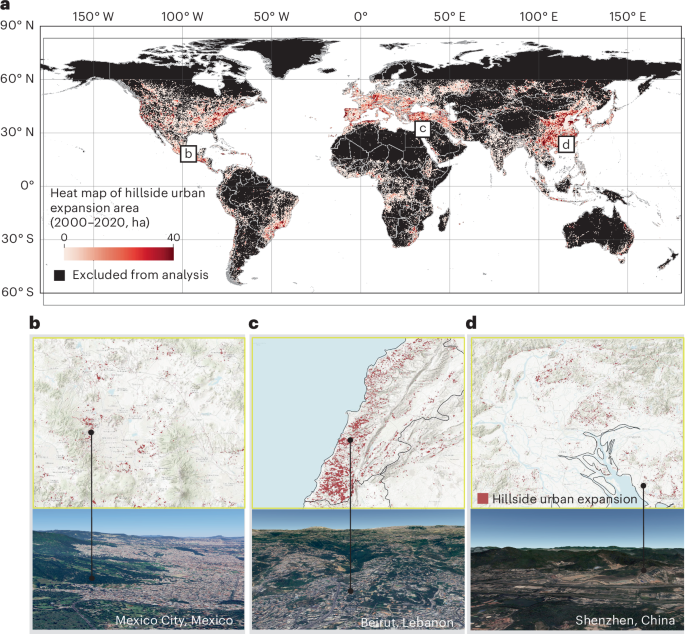
Extensive terrestrial biodiversity threats from global hillside urban expansion
Frolking, S., Mahtta, R., Milliman, T., Esch, T. & Seto, K. C. Global urban structural growth shows a profound shift from spreading out to building up. Nat. Cities 1, 555–566 (2024).
Google Scholar
Lewin, A., Murali, G., Rachmilevitch, S. & Roll, U. Global evaluation of current and future threats to drylands and their vertebrate biodiversity. Nat. Ecol. Evol. 8, 1448–1458 (2024).
Google Scholar
Foley, J. A. et al. Global consequences of land use. Science 309, 570–574 (2005).
Google Scholar
Yang, C. et al. Human expansion into Asian highlands in the 21st century and its effects. Nat. Commun. 13, 4955 (2022).
Google Scholar
Menzori, I. D., de Sousa, I. C. N. & Gonçalves, L. M. Local government shift and national housing program: spatial repercussions on urban growth. Land Use Policy 126, 106548 (2023).
Google Scholar
Shi, K., Yu, B., Ma, J., Cao, W. & Cui, Y. Impacts of slope climbing of urban expansion on global sustainable development. Innovation 4, 100529 (2023).
Yang, C. et al. Human expansion-induced biodiversity crisis over Asia from 2000 to 2020. Research 6, 0226 (2023).
Google Scholar
Feng, Y. et al. Upward expansion and acceleration of forest clearance in the mountains of Southeast Asia. Nat. Sustain. 4, 892–899 (2021).
Google Scholar
Chen, T.-H. K., Pandey, B. & Seto, K. C. Detecting subpixel human settlements in mountains using deep learning: a case of the Hindu Kush Himalaya 1990–2020. Remote Sens. Environ. 294, 113625 (2023).
Google Scholar
Ozturk, U. et al. How climate change and unplanned urban sprawl bring more landslides. Nature 608, 262–265 (2022).
Google Scholar
Kuipers, K. J. et al. Habitat fragmentation amplifies threats from habitat loss to mammal diversity across the world’s terrestrial ecoregions. One Earth 4, 1505–1513 (2021).
Google Scholar
Yang, C. et al. Comparing hillside urbanizations of Beijing–Tianjin–Hebei, Yangtze River Delta and Guangdong–Hong Kong–Macau greater bay area urban agglomerations in China. Int. J. Appl. Earth Obs. Geoinf. 102, 102460 (2021).
Seto, K. C., Güneralp, B. & Hutyra, L. R. Global forecasts of urban expansion to 2030 and direct impacts on biodiversity and carbon pools. Proc. Natl Acad. Sci. USA 109, 16083–16088 (2012).
Google Scholar
Ma, J., Li, J., Wu, W. & Liu, J. Global forest fragmentation change from 2000 to 2020. Nat. Commun. 14, 3752 (2023).
Google Scholar
McDonald, R. I. et al. Research gaps in knowledge of the impact of urban growth on biodiversity. Nat. Sustain. 3, 16–24 (2020).
Google Scholar
Simkin, R. D., Seto, K. C., McDonald, R. I. & Jetz, W. Biodiversity impacts and conservation implications of urban land expansion projected to 2050. Proc. Natl Acad. Sci. USA 119, e2117297119 (2022).
Google Scholar
Wiedmann, T. & Allen, C. City footprints and SDGs provide untapped potential for assessing city sustainability. Nat. Commun. 12, 3758 (2021).
Google Scholar
Xu, Z. et al. Assessing progress towards sustainable development over space and time. Nature 577, 74–78 (2020).
Google Scholar
Bai, X. et al. Six research priorities for cities and climate change. Nature 555, 23–25 (2018).
Google Scholar
Meng, Z. et al. Post-2020 biodiversity framework challenged by cropland expansion in protected areas. Nat. Sustain. 6, 758–768 (2023).
Google Scholar
Soares, R. M. V., Lira, P. K., Manes, S. & Vale, M. M. A methodological framework for prioritizing habitat patches in urban ecosystems based on landscape functional connectivity. Urban Ecosyst. 27, 147–157 (2024).
Google Scholar
van Vliet, J. Direct and indirect loss of natural area from urban expansion. Nat. Sustain. 2, 755–763 (2019).
Google Scholar
Shi, K. et al. Satellite remote sensing data reveal increased slope climbing of urban land expansion worldwide. Landscape Urban Plann. 235, 104755 (2023).
Google Scholar
Tollefson, J. Why deforestation and extinctions make pandemics more likely. Nature 584, 175–177 (2020).
Google Scholar
Shi, K., Wu, Y. & Liu, S. Slope climbing of urban expansion worldwide: spatiotemporal characteristics, driving factors and implications for food security. J. Environ. Manage. 324, 116337 (2022).
Google Scholar
Chang, Z. et al. Hillside urban expansion exacerbates nature and semi-nature habitat landscape fragmentation in China. Int. J. Digital Earth 17, 2368095 (2024).
Google Scholar
Yang, C. et al. Characteristics and trends of hillside urbanization in China from 2007 to 2017. Habitat Int. 120, 102502 (2022).
Google Scholar
Brook, B. W., Sodhi, N. S. & Ng, P. K. L. Catastrophic extinctions follow deforestation in Singapore. Nature 424, 420–423 (2003).
Google Scholar
Rimal, B. et al. Effects of land use and land cover change on ecosystem services in the Koshi River Basin, Eastern Nepal. Ecosyst. Serv. 38, 100963 (2019).
Google Scholar
Piana, P., Brocada, L., Hearn, R. & Mangano, S. Urban rewilding: human–wildlife relations in Genoa, NW Italy. Cities 144, 104660 (2024).
Google Scholar
Ren, Q. et al. Impacts of global urban expansion on natural habitats undermine the 2050 vision for biodiversity. Resour. Conserv. Recycl. 190, 106834 (2023).
Google Scholar
Gao, L. & Bryan, B. A. Finding pathways to national-scale land-sector sustainability. Nature 544, 217–222 (2017).
Google Scholar
Zhou, L., Dang, X., Mu, H., Wang, B. & Wang, S. Cities are going uphill: slope gradient analysis of urban expansion and its driving factors in China. Sci. Total Environ. 775, 145836 (2021).
Google Scholar
Elsen, P. R., Monahan, W. B. & Merenlender, A. M. Topography and human pressure in mountain ranges alter expected species responses to climate change. Nat. Commun. 11, 1974 (2020).
Google Scholar
Li, G. et al. Global impacts of future urban expansion on terrestrial vertebrate diversity. Nat. Commun. 13, 1628 (2022).
Google Scholar
Laurance, W. F. & Engert, J. Sprawling cities are rapidly encroaching on Earth’s biodiversity. Proc. Natl Acad. Sci. USA 119, e2202244119 (2022).
Google Scholar
McDonald, R. I., Güneralp, B., Huang, C.-W., Seto, K. C. & You, M. Conservation priorities to protect vertebrate endemics from global urban expansion. Biol. Conserv. 224, 290–299 (2018).
Google Scholar
The IUCN Red List of Threatened Species ver. 2017‐3 (IUCN, 2017); https://www.iucnredlist.org
Li, Z. et al. SinoLC-1: the first 1 m resolution national-scale land-cover map of China created with a deep learning framework and open-access data. Earth Syst. Sci. Data 15, 4749–4780 (2023).
Google Scholar
Jones, K. R. et al. One-third of global protected land is under intense human pressure. Science 360, 788–791 (2018).
Google Scholar
Zhao, J. et al. Future global conflict risk hotspots between biodiversity conservation and food security: 10 countries and 7 biodiversity hotspots. Glob. Ecol. Conserv. 34, e02036 (2022).
Yang, X. et al. Global basic landform units derived from multi-source digital elevation models at 1 arc-second resolution. Preprint at Earth Syst. Sci. Data (2024).
He, C., Liu, Z., Tian, J. & Ma, Q. Urban expansion dynamics and natural habitat loss in China: a multiscale landscape perspective. Glob. Change Biol. 20, 2886–2902 (2014).
Google Scholar
Leclère, D. et al. Bending the curve of terrestrial biodiversity needs an integrated strategy. Nature 585, 551–556 (2020).
Google Scholar
Gong, P. et al. Annual maps of global artificial impervious area (GAIA) between 1985 and 2018. Remote Sens. Environ. 236, 111510 (2020).
Google Scholar
Huang, X. et al. Toward accurate mapping of 30-m time-series global impervious surface area (GISA). Int. J. Appl. Earth Obs. Geoinf. 109, 102787 (2022).
Zhang, X. et al. GISD30: global 30 m impervious-surface dynamic dataset from 1985 to 2020 using time-series Landsat imagery on the Google Earth Engine platform. Earth Syst. Sci. Data 14, 1831–1856 (2022).
Google Scholar
Fischer, R. et al. Accelerated forest fragmentation leads to critical increase in tropical forest edge area. Sci. Adv. 7, eabg7012 (2021).
Google Scholar
Shi, K. et al. Extensive terrestrial biodiversity threats from global hillside urban expansion. Zenodo (2025).
link