Field Of Study: College students do research at River Ridge | Photos
SPRINGVILLE – Cellist Rob Hodges played a contemplative and meditational piece accompanied by recorded sounds of the ocean at the San Juan Island as well as the sounds of shore birds and other animals, and his wife Catherine Abbey Hodges recited poetry she’d written about the local flora and fauna of the island after the social hour and entertainment before scientific presentations.
Local scientists, ecologists, and community members gathered to hear the students’ presentations as well as enjoy the Hodges’ music, poetry, and good times. A giant commercial swamp cooler and overhead fans helped tremendously in dispelling the sweltering weather.
Everyone enjoyed Rob’s music and Catherine’s poetry tremendously; what a wonderful way to start an extremely interesting evening highlighting the extensive research done at River Ridge Ranch under the tutelage of the Geography Department at Long Beach State. Rob spoke about how he and Catherine explored the intertidal areas between the shore and the forest. He congratulated the students who completed their research projects. And he wished everyone “cool” thoughts.
Catherine Hodges recited poetry about plants, pebbles, and animals, even a tarantula, and listening to the earth; she spoke about repenting, and salvation in the fields. She spoke about living, and plants, animals, and the environment, and there were a few poems about the disastrous local floods in 2023, called “After the Flood” and “Springtime Miracle.”
Long Beach State students and faculty have been studying the local environment around Springville for the last several years.
This summer 8 undergraduates from throughout the United States spent six weeks at River Ridge Ranch, supervised by two graduate students, as well as Long Beach State faculty Dr. Paul Laris and Scott Winslow. Laris, Long Beach State Geography Field Scientist, said it’s his third year running the program getting undergraduate students involved.
He said the graduate students who assist have been working all the time. The research was done on site and at Circle J-Norris Ranch. Students visited and used the labs at UC Merced’s field site in Springville and analyzed their data at SNARL – UC’s Sierra Nevada Aquatic Research Laboratory on the east side of the Sierra.
Many of the undergraduate researchers used technology such as quadcopter and fixed wing drones that carried cameras using LIDAR and 5-band optics.
Besides all their research projects, the students learned to cook, live, eat, and work together, and also went on local field trips to the Yosemite and Sequoia National Parks. Several students had never been at high altitude or seen a Giant Sequoia. Laris thanked ecologists Dr. Gary Adest, and Dr. Barbara Brydolf “for having us here.”
Student Lillian Nix from Lindenwood University, from Saint Charles, Mo., who’s pursuing her Environmental Science and GIS, researched invasive plant species, focusing on Thistle and Mustard plants and how they negatively affect the local environment. She said using a drone and LIDAR was easier than walking into steep terrain. She created an intricate field map, “training” the software to locate all of the types of invasive and non invasive plants..All the plants had different spectral signatures so her analysis was within 80 percent accuracy.
Oak Regeneration and Sapling Recruits was presented by Kyleigh Ruddy from University of Florida.
She tracked Blue Oak tree decline. using Drones, LiDAR and MSP to map and ArcGIS to track variability.
What’s contributing to the problem of Blue Oak decline? Ruddy spent 11 hours identifying the oak species using both ground measurements and drones. Contrary to what might be expected, there were more small blue oaks in sunnier areas.
She found saplings were more abundant at a lower elevation on the mountain and in areas with higher solar radiation, a surprising result.
It was a huge project.
A Scavenger Diversity in California Rangelands research project was done by Brianna Riley and Ali Power from Long Beach State and Scripps College.
The objective was to provide insight into crucial roles scavengers have within ecosystems and investigate differences in scavenger diversity and behavior based on habitat type
Scavengers are really important to ecosystems, and when the apex predators’ populations are in decline, the smaller species take over, said Riley, who set seven camera traps around River Ridge and baited stations with road kill. The students also did a survey of the distribution of road kill.
Virtually all species will scavenge when carrion is available, and scavengers distribute and recycle nutrients, alter disease dynamics, and stabilize ecosystems.
Riley and Power sorted through thousands of pictures for the study and found 11 species of scavengers were visiting their sites. And turkey vultures were in all the habitats as well as ravens.
But the turkey vultures spent more time at the sites, as well as ravens. But they ate at several sites.
There were nine species at the riparian cameras as well as persistent skunks and quails.
There were high encounters with coyotes but they didn’t spend time around the camera traps.
There were lots of turkey vultures with road kill for more than 100 minutes at a camera trap.
They were able to have nine samples before they had problems with the cameras. They’d like to study more and said they had “very cool” data, and they had interesting camera data about invertebrates and animal scavengers.
They said the data was interesting and they learned how much species are using the riparian areas, and how important it is to conserve and rebuild riparian wetlands,
Connor Phillips from the University of North Carolina researched Acoustic imaging of Frogs and other species titled Operation Croak.
He tried to catch and study Blue Bellied lizards but found them hard to find in the field. Instead, he used sound recorders to study the bioacoustics of amphibians and recorded from dusk until dawn and in the recording you could hear birds, bats and frogs.
He recorded at Hidden Pond, the beach, Road Ponds, Unknown Spring, Turtle Cove, and Pasture Spring and mapped the area. He heard a tree frog, bullfrog, and Pacific tree frog.
Phillips said there were four variables to his analysis and it was data heavy. He surmised frogs and toads weren’t in some areas of the ranch.
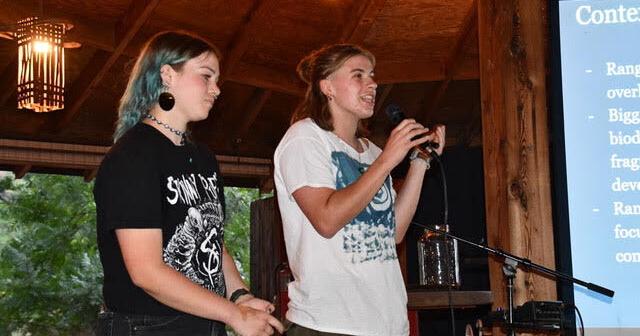
Maya Stokes and Aislinn Lauth researched carbon sequestration. Their project was called Getting to the Core of Carbon Sequestration (C.S). They investigated topsoil and lower layers of soil at River Ridge and Circle J-Norris Ranch.
And they asked if Deer Grass, a native perennial grass with deep roots, helped with C.S. They took samples of soil from both ranches and baked them in a high temperature oven to reduce the sample to carbon. They then determined the percent Soil Organic Carbon.
They took soil samples from upper (0-10cm) and lower (10-40cm) soil areas, and from under trees and in the open, as well as from grazed and ungrazed sites. The canopy covered soil had more carbon sequestration.
They used thorough drawings to illustrate the soil sequestration project that aided in understanding methods used and their conclusions.
Stokes and Lauth both felt they needed more data and more time to work on the project.
link