Mobilising cultural heritage for locally owned adaptation
Heritage as a tool for action
In Sri Lanka, interviews and workshops in rural settlements captured narratives of indigenous environmental knowledge systems (IKS). These narratives highlighted interconnected threads of heritage colonization, gender and rural livelihoods. Research in rural villages identified marginalised environmental knowledge held specifically by women, which was underappreciated in the context of socio-economic pressures to modernise. This finding led to the co-creation of a series of engagements with groups of women to better understand and share the skills, knowledge and values of their ancestors concerning environmental management and disaster preparedness. They identified specific knowledge relating to the Mee Tree (Madhuca longifolia) and its multiple resources22. This tree is valued for its diverse uses, including traditional medicine and oil extraction. Based on the knowledge of elders, hundreds of guides were produced for school aged children so that they could cultivate saplings and benefit from the trees adaptative capacities.
In Yogyakarta, Indonesia, interviews and focus group discussions were conducted to better understand and identify the heritage of the city and its natural landscape of river catchments stretching from the Merapi volcanic area southward to the Indian Ocean. People living along the Kali Code (River Code) identified this landscape as their heritage asset. The cultural value of an urban river system thus enabled discussions on community engagement. That led to the capturing of narratives around landscape changes, including how external influences such as riverbank construction for tourism-centred developments led to behavioural shifts toward the river, transforming it from cultural and environmental significance to a place to discard rubbish. The study sought to understand the correlation between climate-related hazards and the cultural heritage which connects people to their environment. We found that people wanted to share their traditional practices of ‘working together’ across generations to find a way of improving awareness and reducing the polluting behaviors. This resulted in a youth-led theatre production and comic book to share knowledge with others and communicate the need to care for the river as a critical heritage asset.
In South Africa, workshops, a household survey and a series of interviews were conducted in Elandskloof in the Cederberg, which forms part of the Cape Floral Kingdom World Heritage Site. Significant as the site of the first ’successful’ land restitution case in democratic South Africa23, Elandskloof is now an impoverished settlement where IKS loss has disconnected the land from daily life and fractured the community. Through the lens of food heritage, new insights were gleaned about how heritage practices may pave the way to intergenerational knowledge exchange, the construction of a healthier community, and a pathway toward sustainable development. Here the heritage-risk narrative highlights the violent and forced removals from the land that have led to significant vulnerabilities for communities across South Africa. By placing heritage at the centre of discussions with the people of Elandskloof they identified ways to address their vulnerabilities through sharing and growing new local knowledge on horticulture, developing their own plant nursery and sharing the responsibility for its management between generations. They successfully implemented this work with little external support and continue to maintain their heritage food garden, which in their words has become a ‘sign of hope for the future’.
Lessons for locally led adaptation
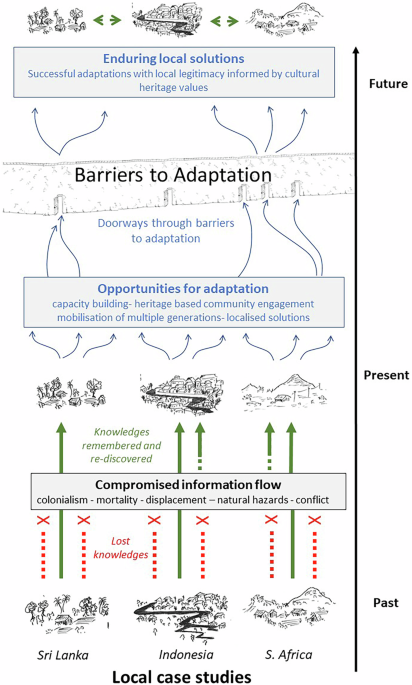
These three distinct studies have common opportunities for adaptation and wider disaster management. By refocussing adaptation efforts on cultural heritage value, significant progress was made in identifying their perceptions of the climate risk-scape, as well as important actions that were viable, situationally appropriate and, essentially, locally owned (Fig. 1).

Illustrating the challenges facing people living in highly vulnerable settings and opportunities of heritage as a tool for adaptation.
The first lesson was recognising how place-based or local knowledge can be lost and found after displacement or in situ oppression. In all three locations, knowledge and skills had been displaced through the adoption of ‘western’ ideals. By focussing on cultural heritage value, people were able to connect and mobilise their beliefs and practices for actions that are locally owned, culturally acceptable and sustainable. For example, in Sri Lanka, a self-organising group of women shared their traditional Mee Tree oil extraction skills and knowledge of its multiple applications from medicine to fuel.
Secondly, sharing of this knowledge and the demonstration of its application led to collective ownership of both the challenge and multiple opportunities. This co-creation began a healing process in Elandskloof that demonstrated to external bodies, such as the local government, that this community was not a ‘lost cause’ and deserves further support to access basic services. In Indonesia, it has led to a communication campaign involving multiple generations working together to share their environmental knowledge and improve the water quality of the River Code.
Thirdly, for the international research team it drove a deconstruction of conventional research practice towards a cross-disciplinary way of sharing knowledge and action. Refocussing discussions on what people value and consider to be heritage, identified ways to address a triple challenge for contemporary policy makers: i) understanding the benefits of place-based knowledge; ii) mobilising this knowledge and iii) empowering local people to continue the development and refinement of their knowledge. This work evidenced that the complex relationships between people and natural systems are dynamically organized and structured across different scales of space and time, creating a panarchy of interactions mediated by information flow.
Through the critical reframing of climate and disaster vulnerability of heritage towards capacity, the resilience of cherished places and people’s cultural knowledge, views and values are better understood. We therefore join the call for researchers and practitioners to consider cultural entry points for locally owned and enacted adaptations.
link