Stir Fried: How the Silk Road created the first Asian food diaspora

In Central Asia, they have mantis, which are typically larger in size. Uzbek mantis, for example, are palm-sized packets wrapped in a thin unrisen dough. Popular fillings for Uzbeki mantis range from root vegetables to mutton, but it always includes a bit of minced onion and lamb fat for flavor. Kazakh and Kygyz manti follow a traditional Uyghur recipe and are normally filled with minced lamb, beef, or horse meat, sometimes with chopped squash or pumpkin, and spiced with black pepper.
Turkish mantis meanwhile, are smaller—more like ravioli or a wonton—and usually topped with a garlic yogurt sauce and red pepper flakes. Bite-sized Afghan mantu are similar to Turkish manti in their size and sauce, and are sometimes served with a tomato-based sauce, a stew, or gorma.
Pelmeni, Kinkali
The stuffed and boiled Russian pelmeni is a direct descendant of jiaozi and was probably carried by Mongols to Siberia and the Urals, where they spread throughout today’s Eastern Europe (thicker-shelled Polish pierogi, thin-shelled Ukrainian vareniki). Like manti, pelmeni were perfect road snacks, and became popular among Russian hunters because they were easy to freeze and cook in the Siberian wilderness. Unlike pierogi and vareniki, pelmeni fillings are always savory and usually raw before cooking. Depending on the region, they are boiled in salted or plain water, or sometimes in a meat broth. They can be eaten alone or topped with sour cream, butter, or other condiments like vinegar or horseradish.
When Mongols brought dumplings to Georgia, they became soup dumplings. The tennis-ball sized dumplings, called khinkali, hold a mixture of meat, spices, and herbs bursting with juice akin to their tinier Chinese cousins. You hold the dumpling by a handle of dough (which is often discarded after eating) formed when closing the top.
Samsa, samosas
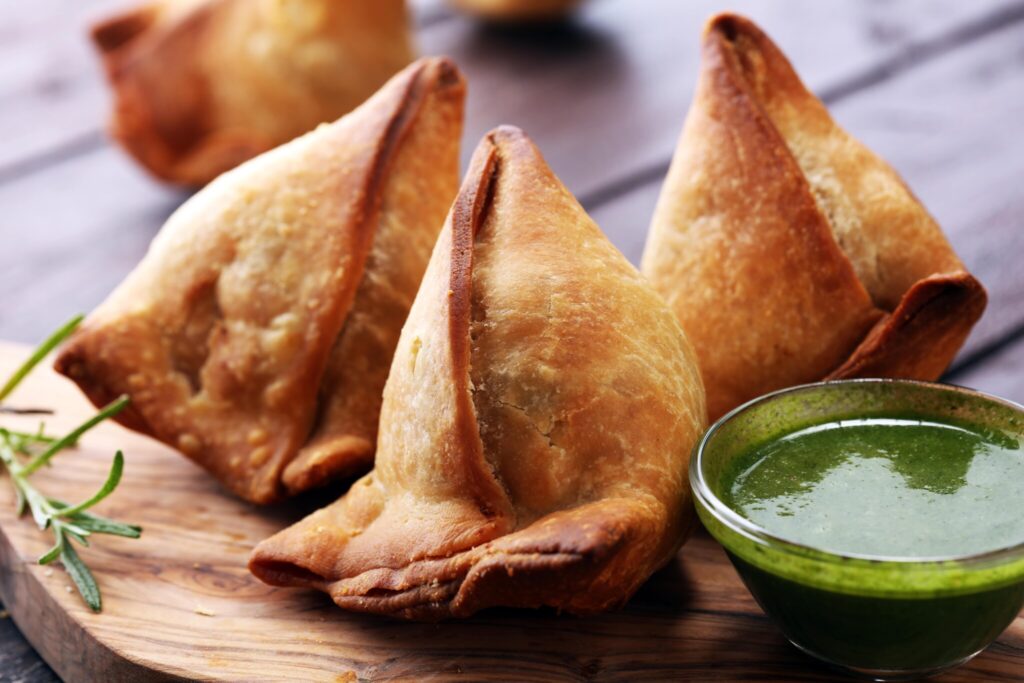
Samsas and samosas are distant cousins of dumplings that traveled from West to East along the Silk Road.
beats_ – stock.adobe.com
Samsas and samosas came the other way on the Silk Road, from West to East when traders brought the early version, sambosas, from the Persian Empire (present-day Iran). In India, sambosas became samosas, stuffed pastries with vegetable or meat fillings, fried in oil and redolent with strong spices. In Central Asia, samsas are baked in the tandoor and sometimes stuffed with sweet fillings like walnuts and hazelnuts.
Noodles
In 2005, archeologists discovered a 4,000-year-old bowl of noodles in Northern China. Before the discovery of these long yellow millet noodles, the earliest written recording of noodles had dated back to a Han Dynasty book from 2,000 years ago. Since then, traders have brought noodles to Central Asian countries across the Silk Road.
Marco Polo and the myth of pasta
Many of us have heard the legend of Marco Polo bringing noodles to Italy. However, that enduring myth was probably planted (or at least encouraged) by Big Pasta; Macaroni Journal, a North American pasta makers trade magazine, first published an article titled “A Saga of Cathay” in 1929, chronicling an Italian sailor who was sent ashore on a small Chinese island and saw a young woman cooking “strings.” While China was the first country to create noodles, pasta had been in the Mediterranean at least since the 4th Century B.C.—long before Marco Polo’s 13th Century expedition.
Laghman
Laghman probably came to Central Asia through the largely Muslim Uyghur and Dungan (Hui) peoples of China, spreading to Persia and Russia as conquerors redrew boundaries. The name “lagman” comes from the Chinese word for “lamian,” or “stretched out dough.” The Greeks had a dish called “laganon,” a layered baked pasta dish that now ends up on our plates as lasagna. In Central Asia and China, laghman refers to homemade, hand-stretched wheat noodles boiled and mixed with stir-fried toppings that give off a lot of juice, which acts as a sauce for the noodles and can be drunk upon completion. Sometimes, the bowl is filled to the top with meat broth. A classic Uzbeki/Uyghur laghman recipe tops hand-pulled noodles with stir-fried chunks of lamb, onion, tomato paste, and bell pepper.
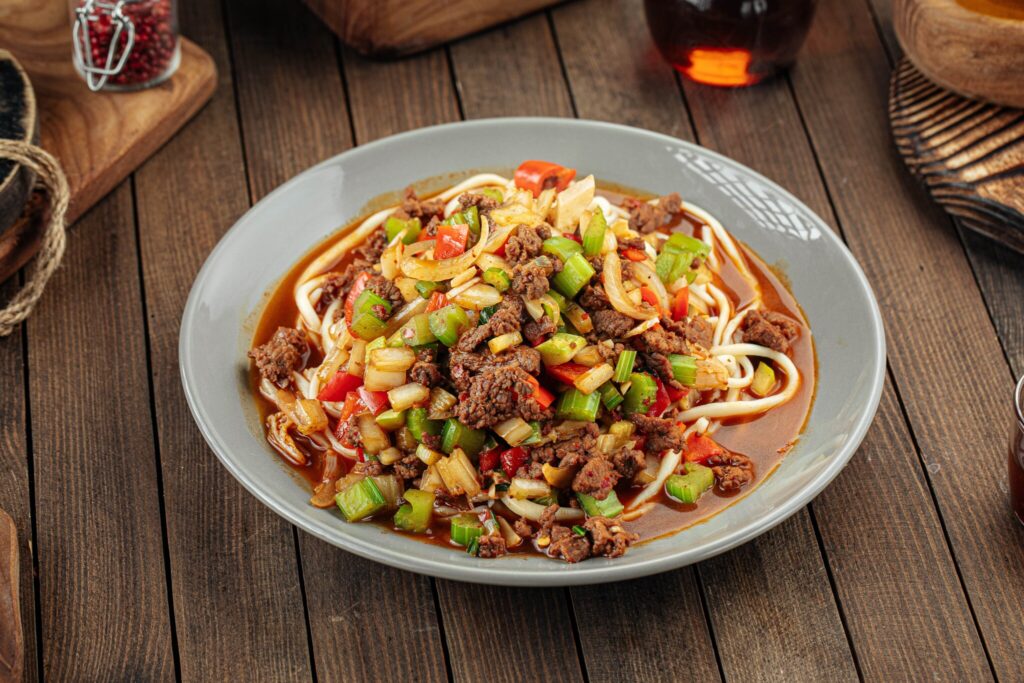
A plate of laghman noodles.
Hihitetlin – stock.adobe.com
We may think of globalization as a modern phenomenon, but the Silk Road was what first set today’s cultural interconnectedness in motion. Ultimately, there are only so many ways to prepare food. Whether noodles were invented in China and brought to the Mediterranean, or if both places independently figured out that drying thin pieces of dough was a time-saving way to cook, it’s perhaps less important than why people continue to eat pasta and noodles—because it’s delicious and convenient.
link