Student groups lead campus conversation on technology’s environmental impact | News
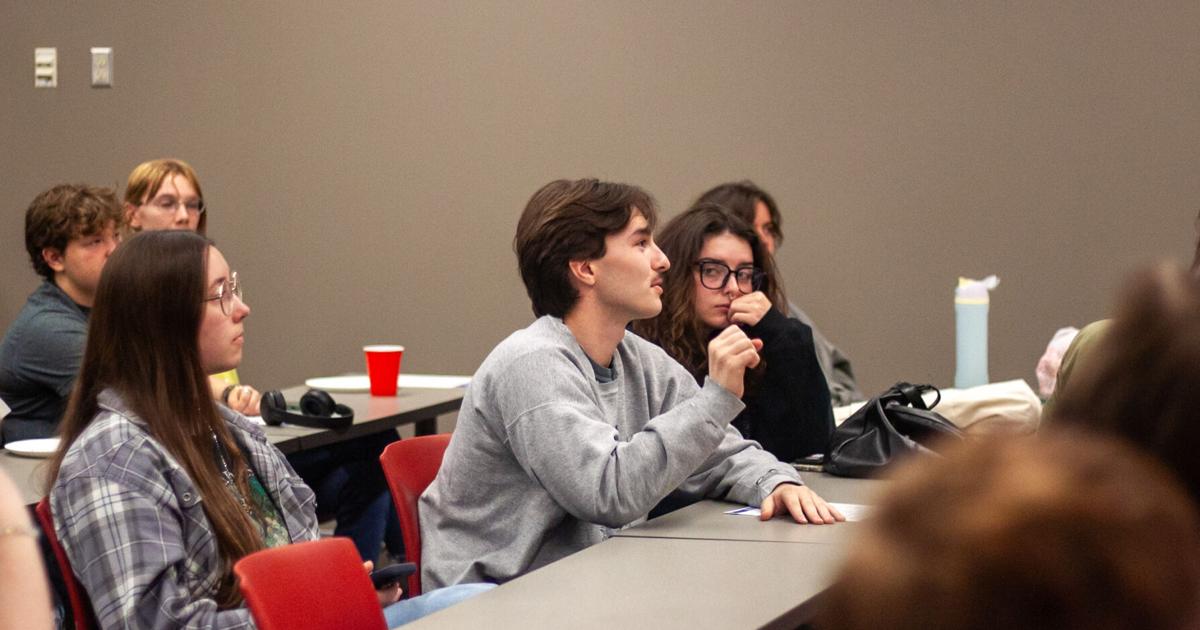
Concerns over artificial intelligence and the proposed Homer City Redevelopment Project brought students together Wednesday in Jane Leonard Hall to discuss how energy production and technology are shaping the future of Pennsylvania’s environment.
The discussion tiled “Data Centers and Environmental Justice in Pennsylvania,” featured Jay Ting Walker, a community organizer for the Clean Air Council, a statewide environmental nonprofit. Walker spoke about the growing connection between fracking, artificial intelligence and energy use in the state.
The event was co-hosted by three student organizations, the IUP College Democrats, the IUP Young Democratic Socialists (YDSA) and the IUP Students for Sustainability (S4S), who began the event with an introduction to their organizations.
“If you’re not aware, all of our state leaders on both sides of the political aisle are in support of an AI revolution which threatens our land, threatens our public health and we’re here to have a conversation about that today,” said IUP College Democrats Outreach Director Abigail Trimble (senior, anthropology).
Walker started the discussion by listing three major take-aways for students to remember after the event; data centers in Pennsylvania are being driven by the fracking industry to drive up fracked gas prices, all of these data centers try to present themselves as “done deals” to get concerned citizens to believe they have no power and that people should be taking anything that the industries say with a grain of salt since they do not mention the downside effects of their plans.
The main topic that Walker focused on was the Homer City Redevelopment Project regarding new data centers planned to be powered by the Homer City Generating Station.
“The project that was proposed is going to be the largest natural gas-fired power plant in the entire country,” said Walker. “There’s a lot of talk about replacing the whole plant, but the size and scale of it is completely different than the coal plant that it’s replacing.”
Walker further explained that the only need for power generation is to power data centers that are specifically used for artificial intelligence (AI) applications.
AI was also a main topic throughout the event, with students raising questions and talking about their own concerns regarding the use of AI and where it might lead to.
“AI can replicate the work of life,” said Walker. “It can replicate the work of teachers, it can replicate the work of multiple white-collar jobs and basically serve as a replacement, a much cheaper replacement.”
Even with the fear of people losing jobs to AI, some are still in favor of using AI when they hear that it can be used for national security reasons, forgetting that it’s expensive and harmful to the economy.
With a large economic gap in Indiana County, the Homer City Redevelopment Project was an economic promise to help the region move away from coal and transition to natural gas.
The proposed could emit over 17 million tons of carbon dioxide emissions yearly, which is more than triple the highest emissions of any polluting facility in the state.
With an increase in carbon dioxide emissions, temperatures could begin to rise due to it being a greenhouse gas and reflecting heat back onto Earth’s surface.
Long-term exposure to air pollutants can increase the community’s risk of respiratory illnesses including asthma, chronic obstructive pulmonary disease and lung cancer.
Walker stated that in the process of convincing the community to be in favor of switching to natural gas, the industry that runs the plant is taking advantage of communities desperate enough to accept the negative impacts that using natural gas from the gas-fired power plant.
The proposed site would have a total generation capacity of 4.5 gigawatts, enough to power about 3.2 million homes for an entire year.
Not only will this new power plant produce air pollution, but it will also contribute to light pollution due to the plant being lit constantly, as well as producing significant noise from fracking operations.
It was also said that there will be about 1,800 fracking wells drilled to power the proposed plant, although Walker highlighted that it’s hard to predict where wells will be drilled and whether they will be drilled in Indiana County.
“Right now, the fracking industry has to pay a tiny amount of money for every well that they drill, and it goes to a clean-up fund, but it doesn’t cover the cost of cleaning up the well at all,” said Walker.
Emphasizing that there is no one in charge of cleaning up the wells, Walker mentioned that enviromentalists try to clean up the wells and celebrate even though there are still massive amounts of unplugged wells that the community cannot clean up.
Corporations and politicians often claim that Indiana residents are in favor of all these things, but Walker said that isn’t the case.
Students were urged to continue learning about the proposed power plant and to speak up about their concerns. When investors see controversy around a topic, they are less likely to invest in the project which can lead to the project being dropped.
It is important to have groups of concerned and unhappy residents go to community meetings and get their opinions heard when no one else is speaking up.
Students can attend meetings for the IUP College Democrats, YDSA or S4S to learn more about how they can help the Indiana community.
“We really just want to educate people on what it means to have a more sustainable lifestyle, more sustainable society and we believe that meetings like this where different organizations are coming together and uniting over a common goal or shared belief is a great way of building a stronger community,” said S4S Vice President Leah Hurst (freshman, anthropology/archeology).
link