
Study on the spatial and temporal differentiation of intangible cultural heritage and its influencing factors in Shandong province
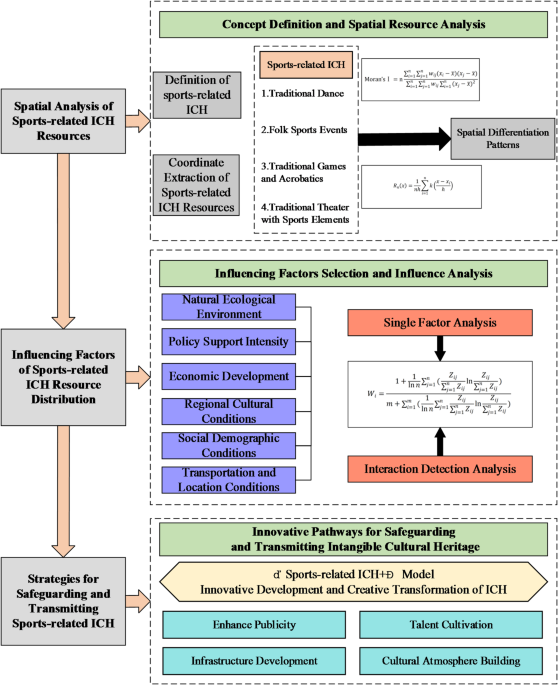
Analysis of spatial distribution characteristics
Types of overall spatial differentiation characteristics
-
(1)
Geographic Concentration Index Analysis
According to Eq. (1), the geographic concentration index G is calculated as 28.56. If the Sports-related ICH in Shandong Province was evenly distributed, its geographic concentration index should be G0 = 25.06, with G > G0. The comparison reveals that the actual geographic concentration index of sports intangible cultural heritage in Shandong Province exceeds the geographic concentration index of uniform distribution in the ideal state, indicating that the spatial distribution of sports intangible cultural heritage in Shandong Province is uneven.
-
(2)
Spatial Autocorrelation Analysis
According to the spatial autocorrelation analysis method mentioned above, combined with ArcGIS 10.8 spatial analysis tool, the clustering degree of the spatial distribution of Sports-related ICH in Shandong Province was calculated, and its correlation characteristics were obtained. The results are shown in Table 1.
According to the calculation results, the Moran’s I index reached 0.94 (Z-score = 16.7, p < 0.01), close to theoretical maximum 1, showing a extremely significant positive spatial autocorrelation, indicating a significant spatial clustering of Sports-related ICH in Shandong Province; The data has been standardised with a Z-value of 16.7 > 1.65 (all within the upper limit of the distribution interval), and the features have passed the test (with a confidence interval reliability of 99%, as shown in Fig. 3). Therefore, there are spatial clustering characteristics in the spatial distribution of Sports-related ICH in Shandong Province.At its core, it represents a spatiotemporal emergence, shaped by the interplay of historical and cultural factors, economic and geographical patterns, demographic and social transformations, as well as policy interventions.

Autocorrelation Map of Sports-related ICH Space.
-
(3)
Average Nearest Neighbor Analysis
The ArcGIS 10.8 nearest neighbor index tool was used to analyze the spatial clustering of sports intangible cultural heritage in Shandong Province, and the results are shown in Table 2.
The results showed that the nearest neighbor index of Shandong Province’s sports intangible cultural heritage was 0.1 < 0.6, and the Z-test values were all lower than −32.5, Average observation distance is about 1.294 km, reflect the actual spatial distribution density of intangible cultural heritage projects. While the expected average distance is about 12.84 km, the gap is up to ten times, indicating a clustered distribution pattern with a significance level of 1% (Fig. 4).

Average Nearest Neighbor Index of Intangible Cultural Heritage in Sports.
-
(4)
Spatial Kernel Density Analysis
To illustrate the density characteristics of Sports-related ICH, kernel density analysis was used for visualization. The “kernel density analysis” tool in ArcGIS software was used to calculate the kernel density of Shandong Province’s Sports-related ICH. Through multiple experiments, the bandwidth is set to 0.25. Then, the natural point breakpoint grading method was used to divide the density areas into 9 categories, resulting in the distribution map of Shandong’s Sports-related ICH kernel density (Fig. 5).

Spatial Density Distribution of Sports-related ICH in Shandong Province.
Based on the kernel density spatial distribution map and the current spatial density distribution pattern of Sports-related ICH, as well as the typical characteristics of the three major economic circles in Shandong Province (Shandong East is the Jiaodong economic circle, Shandong South is the Lunan economic circle, and Shandong North is the provincial capital economic circle) and the low-density valley lines formed by the regional characteristics of Shandong, the spatial distribution pattern of Sports-related ICH in Shandong Province is divided into three typical spatial distribution areas: ① The spatial distribution area of Sports-related ICH in the eastern Shandong peninsula region (defined as Zone 1); ② The distribution area of Sports-related ICH in southern Shandong region (defined as Zone 2); ③ The spatial distribution area of Sports-related ICH in northern Shandong region (defined as Zone 3). There are differences in the distribution density characteristics of various types of Sports-related ICH: four high-density core areas are formed in Jinan, Zibo, Tsingtao, and Heze, with a large range; Forming sub high density areas in Jining and Liaocheng cities, with a relatively large scope; Zaozhuang, Tai’an, and Linyi form a medium density area, while other cities have low or scattered densities. Overall, the overall kernel density zone is mainly concentrated in the surrounding areas of central mountainous regions.
Analysis of characteristics of macro pattern differentiation
-
(1)
Jiaodong Economic Circle—Zone 1
The density core distribution of Zone 1 forms a high-density core point in the northern district of Tsingtao. In terms of administrative planning, Tsingtao, Yantai, Weihai, and Rizhao are the main cities, and they are roughly distributed along the coastline, with the Tsingtao hotspot clearly prominent. From the range of density values, the core density values in the northern district of Tsingtao (1.07–1.48 cells/km2) are relatively uniform, while the core density distribution in other cities is relatively uniform. Among the myriad cities on the Jiaodong Peninsula, Tsingtao distinguishes itself with its prominent economic and demographic conditions, boasting a significant advantage in the sports industry. The remaining areas are relatively balanced. Consequently, Zone 1 demonstrates a characteristic of single-core distribution.
-
(2)
Lunan Economic Circle—Zone 2
The density core distribution pattern of Zone 2 increases from Linyi to Heze, and the spatial distribution of density cores is uneven. In terms of administrative division, Heze has formed a large high-density core, while other cities have formed small-scale density core areas. However, the central mountainous areas have formed typical subsidence areas. From the range of core density values, there are three high-density areas (Mudan, Dongming, Juancheng) within the Heze area, and three low-density distribution areas (Zoucheng, Lanshan, Xuecheng) in the remaining cities, forming a distribution belt extending from east to west. Among them, Mudan, Juancheng, and Zoucheng have kernel density values ranging from 1.06 to 1.31 cores/km2; The density distribution areas of Dongming, Lanshan, and Xuecheng are mainly located within the range of 0.71–1.06 cores/km2; The density distribution in other regions is relatively low, ranging from 0.17 to 0.29 cores/km2. The kernel density zone created by linking the four core hotspots bears resemblance to the urban development corridor in southern Shandong. The Sports-related ICH is concentrated around key cities targeted for development. Consequently, this region falls under the category of a multi-core, unevenly distributed area.
-
(3)
Provincial Capital Economic Circle—Zone 3
Zone 3 forms two high-density cores: Lixia District in Jinan (1.48–2.03 cores/km2) and Zhangdian District in Zibo (1.18–1.54 cores/km2), while Liaocheng, Binzhou, and Tai’an are medium density cores (0.63–0.82 cores/km2). In the low-density areas of Dezhou and Dongying, the density is only 0.18–0.31 cores/km2. Jinan, as the core city and provincial capital of Shandong, as well as the “Qi culture” represented by Zibo, has strong economic, population, and cultural radiation effects, with a wide coverage area. This is also one of the reasons for the wide range of the three hot zones in the area, belonging to the evenly distributed area of the dual core.
Analysis of microscopic pattern differentiation characteristics
Based on the characteristics of kernel density distribution and the distribution of administrative divisions in Shandong Province, the micro pattern differentiation features of the three major areas are defined. The areas where the core distribution of Sports-related ICH is concentrated are defined as spatial differentiation “hot zones”, and vice versa, as “cold zones”. Among them, Zone 1 includes Tsingtao, Yantai, Weihai, and Rizhao; Zone 2 includes Heze, Jining, Linyi, and Zaozhuang; Zone 3 includes Tai’an, Liaocheng, Jinan, Dezhou, Binzhou, Zibo, and Dongying. This study separately counted the quantity and proportion of Sports-related ICH in each city, as shown in Table 3.
Statistics show that the distribution of Sports-related ICH in Zone 3 accounts for 51.54% of the total, with an absolute advantage; Zone 1 has a market share of 19.60%. According to the data, there are significant differences in the spatial distribution of Sports-related ICH in Shandong, mainly distributed in the northern Shandong region (Fig. 6).
-
(1)
The spatial distribution of Sports-related ICH in Zone 1 is mainly along the coastline, with hot-spots formed near Tsingtao, Fushan district, Penglai district, and other areas. The typical characteristics of Sports-related ICH in this area are mainly traditional dance, traditional sports, entertainment and acrobatics, and folk sports projects, forming a “three legged” feature.
-
(2)
The northwest of Heze, the central part of Linyi, the eastern part of Zaozhuang, and the eastern part of Jining in Zone 2 are all hot-spots for the distribution of Sports-related ICH; The spatial distribution of Sports-related ICH in the central region of this area has obvious discrete characteristics and belongs to the cold zone of spatial distribution. From the perspective of Sports-related ICH types, traditional dance, sports, entertainment, and acrobatics are the main forms in this area, forming a “one-sided” characteristic.
-
(3)
Zone 3 is mainly concentrated in the provincial capital(Jinan) and the ancient capital of Qi(Zibo), forming a hot zone of spatial agglomeration. Dezhou and Dongying have relatively less distribution of Sports-related ICH, belonging to the cold zone of Sports-related ICH distribution, mainly with a small amount of Sports-related ICH distribution on the periphery of their main urban areas; The typical characteristics of the Sports-related ICH in this area are that the number of four types of Sports-related ICH exceeds the conventional number, with traditional dance and sports, entertainment and acrobatics being the most significant.

Quantity structure chart of Sports-related ICH.
Analysis of the main influencing factors of spatial differentiation
The spatial differentiation of Sports-related ICH in Shandong Province mainly presents as three hot areas of spatial distribution: the coastal area of eastern Shandong, the plain area of southern Shandong, and the Yellow River area in northern Shandong. The spatial density of the core “cold zone” and “hot zone” of geographical sub regions has become obvious, and their main influencing factors still need further exploration.
Selection of influencing factors
Referring to the research results of relevant scholars2,43,44,45,46,47,48,49,50,51,52,53, combined with the matching characteristics of spatial relationships of Sports-related ICH, and considering the availability, correlation, and scientificity of data comprehensively, this study takes the core density stratification of provincial and national Sports-related ICH as the dependent variable, selects 6 dimensions of natural ecological environment, social population conditions, economic development level, regional cultural base, transportation location conditions, and policy support as independent variables, and 13 influencing factors to establish an indicator system, as shown in Table 4. Before using the geographic detector method, the independent variables were stratified using the natural breakpoint method, and each influencing factor was divided into six categories, with consistent grading standards at different stages.
Geographic detector analysis results
-
(1)
Single factor analysis
Import the influencing factors into the geographic detector model to obtain the impact values of each influencing factor on the spatial distribution of Sports-related ICH resources in Shandong Province.
The results indicate that the size of the influencing factors on the spatial distribution pattern of Sports-related ICH resources in Shandong Province is: x5 > x7 > x8 > x12 > x10 > x11 > x9 > x13 > x4 > x1 > x6, among which x2 and x3 did not pass the 1% significance test (Table 5 and Fig. 7), and the results are no longer displayed. The indicators of slope and distance from water system do not significantly drive the spatial distribution pattern of Sports-related ICH in Shandong Province. Overall, the level of economic development and demographic conditions play a dominant role in the spatial distribution pattern of Sports-related ICH, while transportation location and regional cultural base play important roles. The impact of natural ecological environment and policy support is relatively weak.

Influencing factors q value.
The level of economic development is the core factor that affects the basic spatial pattern and sustainable development of Sports-related ICH. Population density, per capita disposable income, and urbanization rate are strong influencing factors on the spatial distribution of Sports-related ICH in Shandong Province, with q-values of 0.2337, 0.1214, and 0.1185, respectively. Sports-related ICH in Shandong Province is concentrated in densely populated areas with developed economic development and urban construction, including Jinan, Tsingtao, Linyi, Weifang, etc., showing a trend of extending from the Jiaodong economic circle to the provincial capital economic circle and then to the Lunan economic circle. The central mountainous areas are constrained by terrain, with a low urbanization rate, sparse population, and underdeveloped secondary and tertiary industries, mainly clustered and distributed along the boundary of the central mountainous areas. The number of traditional villages, the number of cultural institutions, the distance from national highways, and the total mileage of national highways also have a prominent influence, with quantile values (q) ranging from 0.067 to 0.118 respectively, indicating the uneven distribution of regional cultural resources in Shandong Province. The profound cultural foundation is the historical tracing of the origin of Sports-related ICH. At the same time, the modern three-dimensional comprehensive transportation system in Shandong Province enhances the accessibility of Sports-related ICH, stimulates the demand for traditional sports culture among potential tourists, and promotes the cultural flow of inheritors, thereby promoting the dissemination and inheritance of Sports-related ICH. The policy support and natural ecological environment have a relatively small impact on the spatial distribution of Sports-related ICH in Shandong Province, indicating that the correlation between policy orientation and economic and demographic factors is relatively small compared to topography and hydrology. Different topography and hydrology factors form traditional sports projects with different characteristics. At the same time, for the economic benefits of Sports-related ICH inheritors, without economic income sources and leisure time, it is difficult for Sports-related ICH to originate, inherit, develop and protect. Policy orientation only plays a guiding role in the main development direction of the region, and does not play a leading role.
-
(2)
Interaction detection analysis
The explanatory power of each influencing factor significantly increased after interaction, showing varying degrees of dual factor enhancement or nonlinear enhancement, indicating that the spatial pattern of Shandong Province’s Sports-related ICH is the result of the joint action of six influencing factors (Fig. 8).

Interactive Detection Results of Influencing Factors in the Figure.
The explanatory power of the interaction between population density and other factors is higher than 23.38%, followed by the explanatory power of the interaction between per capita disposable income and other factors at over 12.14%, and the explanatory power of the interaction between urbanization rate and other factors at over 11.86%. This indicates that the spatial pattern of Shandong’s Sports-related ICH is mainly influenced by the combined effects of economic development level, social demographic conditions, and other factors.
The interaction between distance from the water system and population density, per capita disposable income, urbanization rate, and total length of national highways is much greater than its own influence, with explanatory power of 0.2772, 0.1495, and 0.3057. Therefore, it can be concluded that:
-
(1)
Sociodemographic conditions are a key factor influencing the emergence of entertainment and culture. The higher the population, the stronger its ability to possess historical culture and entertainment activities, which in turn affects the origin of Sports-related ICH and is one of the important influences on the clustering characteristics of Sports-related ICH.
-
(2)
The transportation location reflects the dissemination and influence range of regional civilization and culture. The more developed the transportation conditions, the farther the distance that regional sports and culture can be conveyed, and the larger the influence range. It is also the fundamental influencing factor that affects the spatial agglomeration and distribution of Sports-related ICH.
-
(3)
Economic ability determines people’s lifestyle and ideological trends, among other “software” factors. “The economic foundation determines the superstructure”. The higher the level of economic development, the more advanced the social ideology tends to be. People have leisure time for sports and entertainment activities, and have a positive awareness of protecting traditional culture.
In addition, the influence of distance from the water system is relatively weak in single factor detection, with an explanatory power of 0.0017. However, the influence of distance from the water system increases linearly after interacting with the total length of national highways, urbanization rate, per capita disposable income, and population density, with explanatory power values of 0.1432, 0.1562, 0.1495, and 0.2462, respectively. This indicates that the development of the sports and cultural industry needs to be fully reflected in the spatial distribution of Sports-related ICH in Shandong Province through the joint action of factors such as traffic conditions, social population, and economic level. Similarly, the influence of slope on single factor detection is relatively small (q = 0.0043), but after interacting with other factors such as urbanization rate, per capita disposable income, and population density, the q values significantly increase, reaching 0.1384, 0.1408, and 0.2444, respectively. The policy support intensity factor is the weakest influencing factor that passes the significance test (q = 0.0553). There is a significant time lag between the introduction of a policy and its actual effect, and a new policy may take several years to show its effect in local intangible cultural heritage practices. Moreover, the core driving force for sustainable intangible cultural heritage inheritance often comes from the willingness and recognition of local people’s participation. Policy only plays a catalytic role as a “catalyst”, but it is difficult to replace the spontaneous vitality generated by its cultural roots. Additionally, because the geographical detector detects the relative results between selected factors, it does not mean that policy support intensity has no influence on the spatial distribution of sports intangible cultural heritage. It is merely masked by economic, demographic, and other factors54.
link